
Richentek projects · feed pellet & mash lines
PROJECTS Feed Pellet Lines Built Around Your Site
Every line on this page started as a set of constraints: a formula, a building, a power supply, a budget, and a market that buys feed in 25 kg bags. We design the plant around those constraints instead of selling a fixed package — a 500 kg/h feed pellet line for one farm or a 6000 kg/h feed pellet plant on three levels, pellets or mash, one machine or a complete turnkey project.
Seven line sizes documented in detail · pellet and mash feed production lines · designed to your building, your formula and your local power supply

Custom by default
No Two Feed Pellet Production Lines We Ship Are Identical
A feed pellet line is a chain of machines, and every link is set by your conditions: what you grind, how fine, how much oil goes in, how tall your building is, whether you have steam, and what your grid actually delivers. We start from those answers and build the machine list backwards from them.

Designed from your answers, not from a catalogue
The same 2000 kg/h output can be two PM-400 flat die mills on a 25 × 6 m floor, or one HM-320 ring die mill with a conditioner and a cooler. Different capital, different pellet quality, different spare-parts profile — and both are real projects we quote, which is why both have their own page.
Capacity is only the first question. The second is the pellet: a 2–3 mm aquatic die and a 6 mm cattle die are not the same machine setting, and a high-fat formula changes the conditioner, the cooler and the conveying.
The third is the site. We design to the building you already have — its height, its floor, whether raw material arrives in bags or in a tipper — and to the power you actually get.
Your building
Layout to the space you have
Tower, single storey, or a shed with a 6 m eave: we draw the section first and fit the machines into it, rather than handing you a layout and asking for a new building.
Your formula
Die, conditioner and cooler set to the recipe
Hole diameter, die thickness, steam retention time and cooler air are chosen for your species and your raw materials, not copied from a standard list.
Your market
Bag, jumbo bag or bulk truck
Finished feed leaves the plant the way your customers buy it — 25 or 50 kg bags, big bags, or a bulk loading spout into a truck.
Line sizes
Seven Feed Pellet Line Sizes, Each Documented in Detail
Every size below has its own page with the factory configuration, installed power, footprint, process flow, layout drawing and photographs of the machines. Start from the tonnage you can sell and work up or down from there.


Sizes between these are normal, and we quote them constantly. The feed pellet production line overview carries the full capacity table from 200 kg/h to 20 t/h, including the ring die and flat die options at each step.
Three architectures
Flat Die, Ring Die and Tower — How the Line Changes With Size
The machine that makes the pellet changes shape as the plant grows, and so does everything around it. These are the three families our projects fall into.

Flat die, 500–1000 kg/h: the low-building line
Flat die mills are horizontal and short. The whole line fits under a 4–6 m roof, needs no steam, and can start on a single 30 kW motor and grow by adding a second mill. This is what most first-time feed businesses build, and it is why we document three sizes of it.
It is also the most forgiving line to run: a flat die mill tolerates a coarser grind and a wider moisture band than a ring die, and a replacement die costs a fraction of a ring die.
Ring die at 2000 kg/h: one mill, a denser pellet
At two tons an hour the real choice is between two flat die mills and one ring die mill. The ring die gives a denser pellet, a longer die life and a single point of maintenance — but it wants conditioned mash, so a steam generator comes with it.
We build both, and the two pages sit side by side so you can compare them machine by machine: 110 kW of flat die against 120 kW of ring die, on the same 25 × 6 m floor allowance.


Tower lines at 5000–6000 kg/h: height instead of floor
Above three tons an hour, conveying horizontally costs more in steel and power than lifting once. The plant becomes a tower: silos at the intake, grinding and mixing on an upper level, pelleting below, cooling and bagging at floor level.
The 5000 kg/h feed pellet line does it with two Ø350 mm mills on one platform so one can be serviced while the other runs. The 6000 kg/h feed pellet line does it with a single Ø400 mm mill and a 15 × 15 m footprint.
What we customise
Six Things We Change on Every Feed Pellet Line
None of these is an extra. They are the questions we ask before the quotation exists.
01 · Capacity
Sized to what you can sell
500 kg/h to 6 t/h in documented steps, and any point between them. We would rather quote a 2.5 t/h plant that runs full than a 5 t/h plant that runs at half load.
02 · Species
Poultry, cattle, pig, rabbit, fish, shrimp
The die, the grind and the conditioner follow the animal: a crumble for chicks, a 4–6 mm pellet for cattle, a dense sinking pellet for shrimp.
03 · Raw material
Grind, dose and convey to your materials
Maize, soybean meal, cassava, rice bran, DDGS, fish meal, limestone, oil. High-fibre and high-fat formulas change the grinder, the mixer and the conveying.
04 · Utilities
Steam, power, air and water to site conditions
Steam generator or your existing boiler; motors and cabinet built to your voltage and frequency; compressed air for cylinders; water for the conditioner where you have it.
05 · Automation
Manual, batching or full PLC
From push-button starters to automatic batching with recipe memory, interlocked start-up and remote fault reporting. The cabinet is sized for the level you choose.
06 · Finished feed
Pellets, crumble or mash — and how it is packed
Cooling, crumbling, sieving and fat coating are added or left out; packing can be a 25 kg bagging scale, a jumbo bag station or a bulk loading spout.
Mash feed lines
Mash Feed Production Lines — Grinding, Mixing and Packing Without Pelleting
Not every market wants pellets. Where feed is sold as meal, or where animals are fed wet, a mash feed production line does the same intake, grinding, dosing and mixing work and stops before the pellet mill.

What a mash feed production line contains
Intake and cleaning, a feed hammer mill with cyclone and bag filter, batching or continuous dosing, a horizontal ribbon mixer with optional oil or molasses addition, and a bagging scale. No conditioner, no pellet mill, no cooler — and therefore no steam boiler and a far lower connected load.
It is also the cheapest way to start. The same steel, the same building and the same conveying can take a pellet mill and a cooler later, so a mash line is a first phase rather than a dead end. Several of the plants in our photographs began that way.


Mash and pellet lines share most of their machines, so the choice is not permanent. Tell us the species and the tonnage and we quote the mash version with the same detail as the pellet lines: machine list, installed power, footprint and a layout drawing. See the mash feed production lines page for the reference builds and the stage-by-stage layout, or the full capacity range if you want pellets. Ask for the mixer and hammer mill pages if you are building the line up machine by machine.
Video
These Lines Running
Footage from our own workshop and from customer sites — flat die lines, ring die lines and a 4 t/h ruminant plant in production.

Our Feed Pellet Machines Showroom Complete Animal Feed Pellet Plant Solutions
The machine showroom behind these projects: pellet mills, hammer mills, mixers, coolers and packing equipment for complete animal feed pellet plants.
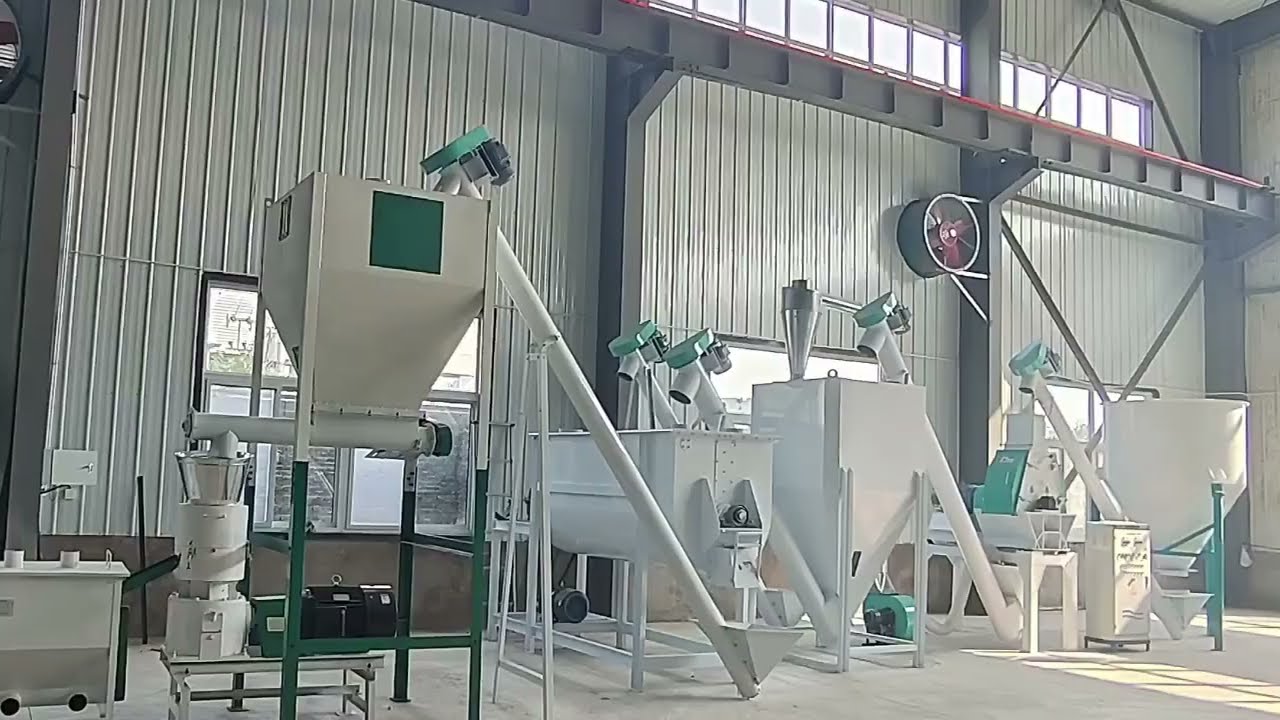
Our Feed Pellet Production Lines
The lines we build, filmed end to end — hammer mill and mixer through to pellet mill, cooler and bagging scale.

Small Flat Die Pellet Production Lines Show
Small flat die lines working — the format most of our 500–1000 kg/h feed pellet projects start from.

Ring Die Animal Aquatic Feed Pellet Machine Video Show Structure and Working Principle
How a ring die feed pellet mill is built, and why the die, roller and conditioner settings decide pellet quality on aquatic and ruminant feed.
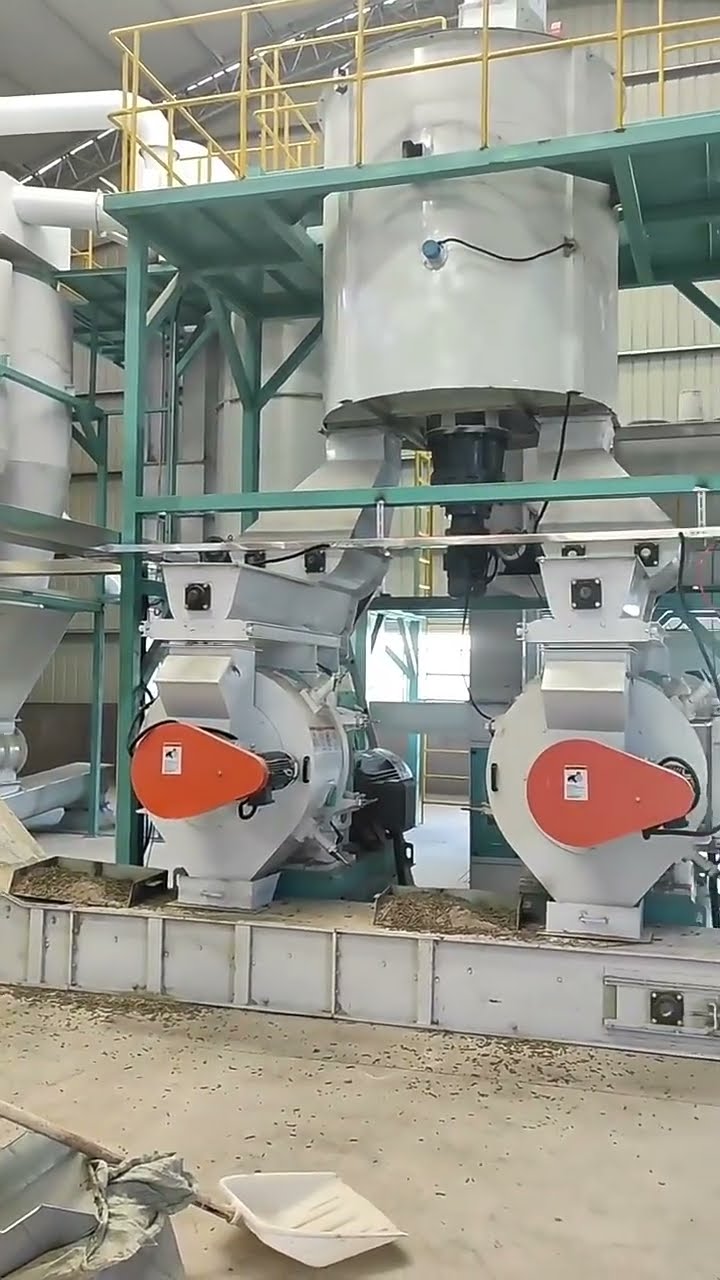
4TPH Ruminant Animal Feed Pellet Plant. Complete Feed Pellet Solution
A 4 t/h ruminant feed pellet plant running on conditioned mash, with cooler and bagging line.
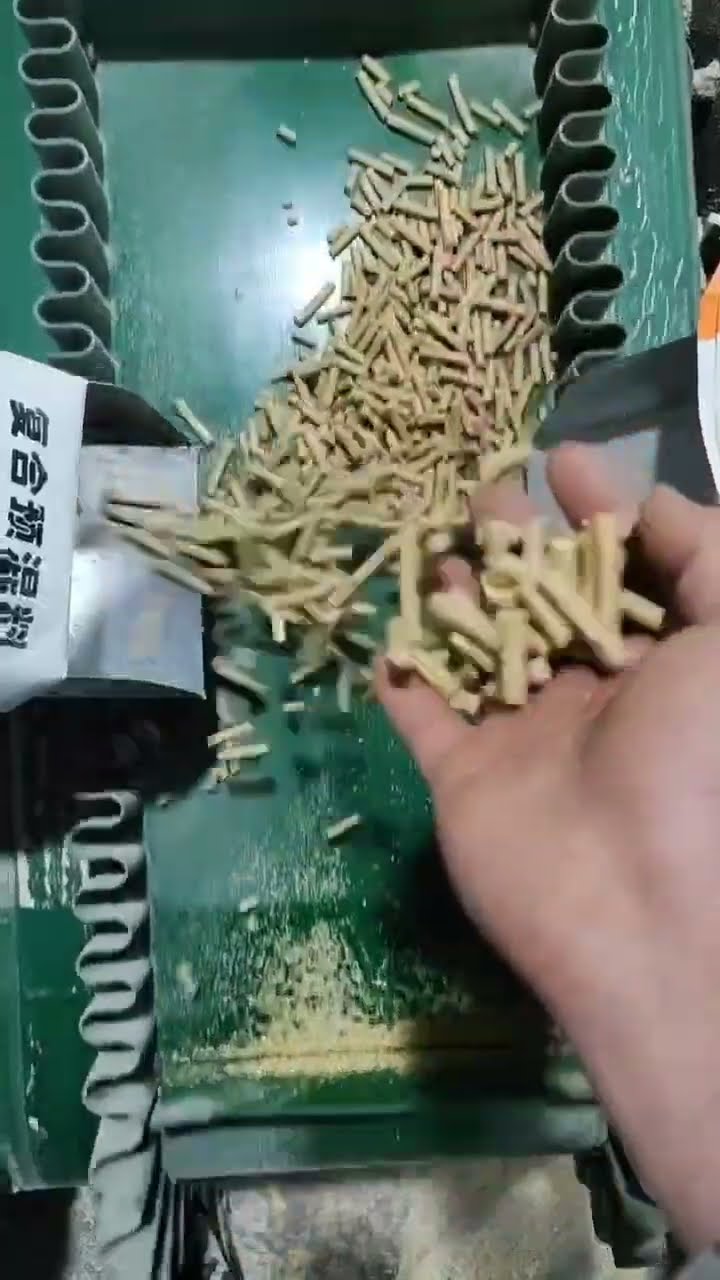
Small Feed Pellet Production Line Flat Die Animal Feed Pellet Machine
A small flat die feed pellet production line on test: crusher, mixer, pellet mill and the finished pellet coming off the die.
Installed plants
Feed Pellet Lines We Have Installed
Ten plants on file, from a 1 t/h farm line in Jiangsu to a 10 t/h plant in China and an 8 t/h plant in the United Kingdom. Capacities and locations are the customer’s, not a catalogue range.

Every plant is drawn before it is built
Each of these started as a drawing like the ones on the line pages: a section through the building with the machines placed, the elevator centres fixed and the bagging point chosen. The customer signs that drawing before we cut steel.
If you are planning a line, send us your building dimensions or a photograph and we will return the same drawing marked to your space — that is usually the fastest way to find out whether your building can take the tonnage you want.


Case studies
Export and Installation Cases
Complete plants, single machines and equipment sets we have shipped — each one with the customer’s own photographs.


More installations and machine-level cases are in the case archive.
FAQ
Questions About These Projects
Can you design a feed pellet production line for my capacity, not just your standard sizes?
Do you supply mash feed production lines as well as pellet lines?
What do you need from us to quote a feed pellet line?
Can the plant be extended after it is running?
How long does a project take from order to running plant?
Do you build to our local power supply and climate?
Tell us what you need to produce
Send the tonnage, the species, the raw materials, your building dimensions and your voltage — we reply with a machine list, a power schedule and a layout drawing. Email info@pelletmachines.net or WhatsApp +86 186 0385 1787.
Send us your constraints and we will design the line
Tonnage, species, building, power supply, packing. That is enough for us to come back with a machine list and a drawing.