
Wet Type Fish Feed Extruder
30–60% More Capacity, Export-Grade Pellets
The wet type extruder adds a steam conditioner ahead of the barrel. Steam pre-cooks the mash, so the screw does less work, throughput rises 30–60% over the same dry model, and the finished pellet is more durable with better water stability. This is what commercial aquatic feed plants run.
Reference FOB price: USD 2,900 – 32,000 by model. Steam requirement and boiler sizing supplied with every quote.

Why Commercial Plants Choose Wet Type
Steam conditioning is not a small upgrade. It changes what the machine can produce: more tons per hour, higher fat tolerance, better durability and a pellet that survives handling and export.
30–60% more
Steam pre-cooks the mash, so the screw spends less energy on heating and more on conveying.
Fewer fines
Even cooking means the pellet binds properly; less breakage in transport.
Up to 20%+
With vacuum coating, wet type handles the oil levels shrimp and premium fish feed require.
Longer barrel life
Steam lubricates and pre-softens, cutting barrel and screw wear versus dry running.
Making Shrimp Feed That Holds Together
Shrimp feed is a different product from floating fish feed, and the wet type extruder is where most of it gets made. The pellet has to sink, hold together in water for hours rather than minutes, and carry an oil load that a dry barrel cannot take.
Start with the oil. A shrimp or marine diet commonly carries 8–12% added oil, and high-energy fish diets go past 20%. Fat above roughly 10% in the mash lubricates the screw, cuts the shear that gelatinises starch, and the pellet stops binding. So you extrude a lean, well-cooked pellet with an open pore structure, then spray fish oil on under vacuum.
That is what the vacuum fish oil coater buys you: the oil goes into the pores instead of sitting on the skin, and the pellet stays intact. It is only practical on a wet type line, because the pellet has to be durable enough to survive the coating drum. A dry type fish feed extruder reaches about 10% fat and stops there.
Water stability matters more in shrimp feed than in fish feed. A pellet that breaks down in the first hour is feed you paid to make and then fed to the pond bottom. Steam conditioning gelatinises more starch, which seals the surface and holds the pellet together — the second reason shrimp producers go wet type.
One sizing note. At high tonnage, sinking shrimp feed is often made on a ring die aquatic feed pellet mill, which is cheaper per tonne. The wet type shrimp feed extruder earns its place when you need the fine end of the size range, a high oil load, or floating product from the same machine. Still comparing models? The full extruder range compares dry and wet side by side.
Ask for the shrimp formula set with the vacuum coating and drying settings included. Request shrimp feed data.

Wet Type Fish Feed Extruder Specifications
Capacity figures below are for wet configuration with steam conditioning. The same models in dry configuration produce 30–40% less — see the dry type fish feed extruder page.
| Model | Capacity (T/H) | Main power (kW) | Feeder (kW) | Screw dia. (mm) | Cutter (kW) | Conditioner (kW) |
|---|---|---|---|---|---|---|
| DSP60 | 0.18–0.20 | 15 | 0.4 | 60 | 0.4 | 0.37 |
| DSP70 | 0.30–0.35 | 18.5 | 0.75 | 70 | 0.4 | 1.1–1.5 |
| DSP80 | 0.40–0.45 | 22 | 0.75 | 80 | 1.5 | 1.5–2.2 |
| DSP90 | 0.50–0.55 | 37 | 1.1 | 90 | 2.2 | 2.2–3.0 |
| DSP120 | 0.7–0.8 | 55 | 1.1 | 120 | 2.2 | 2.2–3.0 |
| DSP135 | 1.0–1.2 | 75 | 1.5 | 135 | 3.0 | 3.0–4.0 |
| DSP160 | 1.8–2.0 | 90 | 2.2 | 155 | 3.0 | 4.0 |
| DSP200 | 3.0–5.0 | 132 | 2.2 | 195 | 4.0 | 5.5 |
Steam requirement roughly 0.2–1.2 t/h depending on model at 0.3–0.6 MPa. Pellet diameter 0.9–10 mm by die change. Floating, slow-sinking and sinking products from the same machine.
What you need at your site
- Steam boiler — we size it, typically 0.2–1.2 t/h by model.
- Three-phase power at your local voltage and frequency.
- Grinding below 0.5 mm — an ultra-fine hammer mill.
- Dryer and cooler before bagging, plus optional vacuum coater.
- Operators comfortable managing steam pressure and temperature.
Vacuum coating: the upgrade that pays
Fat above about 10% weakens the pellet structure if added before extrusion. A vacuum coater sprays fish oil onto finished pellets under vacuum, so the oil is absorbed rather than sitting on the surface.
That is how premium feed reaches 20%+ fat without falling apart — and it is only practical on a wet type line. See the vacuum fish oil coater.
Quick quote — wet type extruder and boiler
Tell us the species, target T/H and whether you already have steam. We reply with the model, boiler size and landed price. Send the details to info@pelletmachines.net or WhatsApp +86 186 0385 1787 — engineers reply within 12 hours.
How a Wet Type Extruder Works: Steam Cooks, Screw Shapes
That division of labour is the whole reason a wet type machine out-produces a dry one of the same size.
- 1Fine grinding
Raw material ground below 0.5 mm; starch content drives expansion.
- 2Steam conditioning
Steam at 0.3–0.6 MPa pre-cooks mash to 80–90 °C before it enters the barrel.
- 3Extruding
The screw builds pressure to about 40 bar; less energy spent on heating, more on throughput.
- 4Expansion
Mash exits the die to atmospheric pressure and puffs up — this is what makes feed float.
- 5Drying, coating, cooling
Dryer to storage moisture, optional vacuum oil coating, then counterflow cooler.

Wet type fish feed extruder — working video
Watch the wet type machine running with steam conditioning at higher capacity.
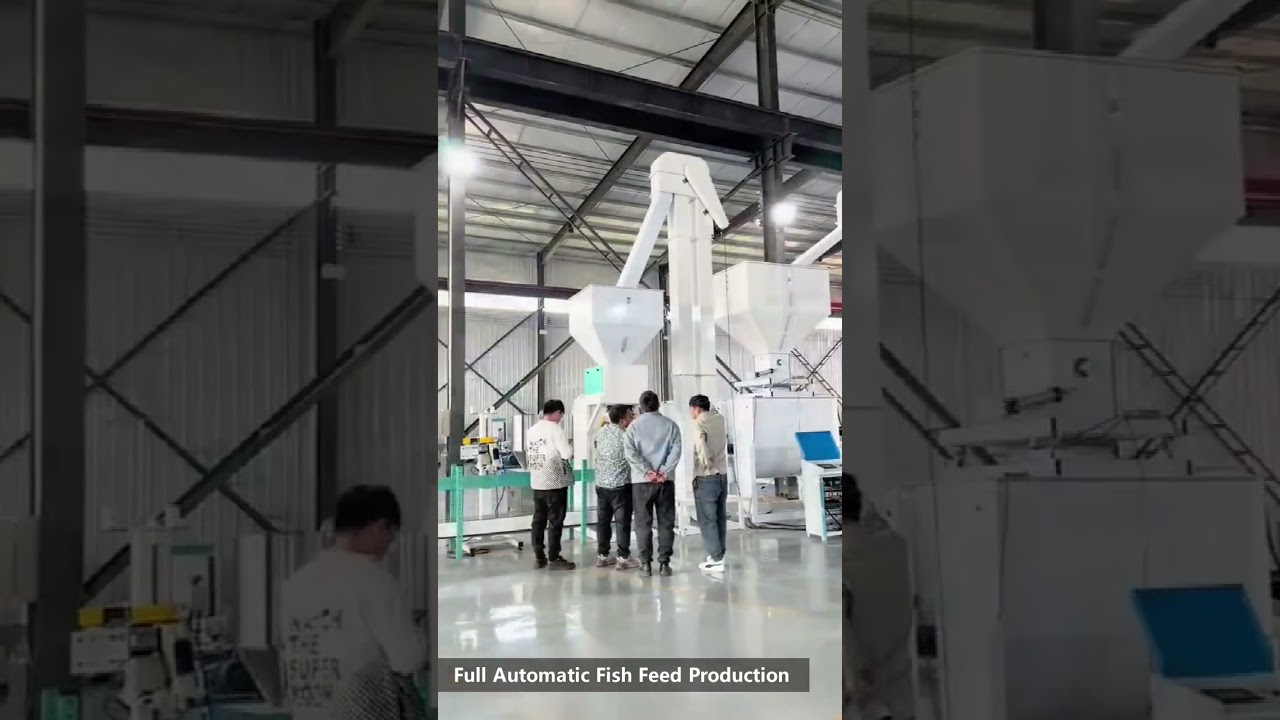
Complete wet type fish feed production line
A full wet type line: extruder, dryer, coating, cooler and packing in sequence.
Wet Type Lines and Extruders in Production
Real clips — wet type extrusion, complete lines and pet food production on the same platform.

Shorts play vertically — tap through to YouTube for the full clip and more from the @PelletMachines channel.
When wet type is the right call
Choose wet type when you have confirmed demand above roughly 1 T/H, when you are supplying commercial farms or exporting, or when your formula needs more than about 10% fat. In all three cases a dry type machine will hold you back within a year.
The boiler is the real barrier, not the machine. If you already have steam — for a pellet mill conditioner or any other process — the incremental cost of going wet type is small and the capacity gain is immediate.
If you have no steam and no near-term plan to install it, start on the dry type fish feed extruder, prove the market, then add a wet type machine as a second line rather than replacing the first.

- 30–60% more capacity than the same dry type model
- Better pellet durability and water stability, fewer fines
- Fat levels up to 20%+ with vacuum coating
- Lower barrel and screw wear than dry running
- Floating, slow-sinking and sinking from one machine
- Free floating, sinking and pet food formulas supplied
Wet Type vs Dry Type Extruder: One Table
Capacity, capital and formula freedom. Everything else is secondary.
| Item | Wet type extruder (this page) | Dry type extruder |
|---|---|---|
| Steam boiler | Required, 0.2–1.2 t/h | Not required |
| Capacity, same model | 0.18–5 T/H | 30–40% lower |
| Pellet durability | Better; fewer fines | Good |
| Fat tolerance | Up to 20%+ with vacuum coating | Up to about 10% |
| Barrel and screw wear | Lower | Higher |
| Purchase price | About 15–25% higher | Lower |
| Operating skill | Needs steam management | Simpler |
| Best for | Commercial plants, export, high capacity | Startups, no boiler, pilot plants |
Dry type specifications are on the dry type fish feed extruder page.
Steam, Power and Downstream Sizing
Getting the boiler and dryer right is what separates a wet type line that runs from one that underperforms.
| Model | Capacity (T/H) | Steam (t/h) | Installed power (kW) | Dryer needed | Floor area |
|---|---|---|---|---|---|
| DSP60 | 0.18–0.20 | 0.2 | ~20 | Small belt dryer | ~15 m² |
| DSP70 | 0.30–0.35 | 0.3 | ~25 | Small belt dryer | ~20 m² |
| DSP90 | 0.50–0.55 | 0.4 | ~45 | Belt dryer | ~30 m² |
| DSP120 | 0.7–0.8 | 0.6 | ~65 | Belt dryer | ~40 m² |
| DSP160 | 1.8–2.0 | 0.9 | ~105 | Belt dryer + coater | ~60 m² |
| DSP200 | 3.0–5.0 | 1.2 | ~150 | Multi-pass dryer + coater | ~90 m² |
Figures are for the extruder and its immediate downstream equipment, excluding grinding and mixing. We size the complete line as one project — see the fish feed production line.
What Boiler a Wet Type Extruder Actually Needs
The 0.2–1.2 t/h in our table is boiler capacity, not the mass of steam injected into the conditioner. Injected steam is a small share of throughput. The boiler is rated larger because it has to hold pressure through peaks, supply the dryer when that is steam-heated, and cover the pipe runs.
Pressure is the number to get right: 0.3–0.6 MPa, saturated. Saturated, not superheated. The cooking comes from latent heat released as the steam condenses on the mash. Superheated steam gives that up more slowly. Dry steam matters too; a boiler running wet carries droplets that make the mash patchy.
Match the boiler to the model, then add margin. A DSP60 at 0.18–0.20 T/H needs about 0.2 t/h. A DSP200 at 3–5 T/H needs about 1.2 t/h. Under-sizing is the error we see most, and the symptom is an extruder that runs at half output while everyone blames the machine.
Can a thermal oil heater replace the boiler? For the dryer, yes — an indirect air heater on thermal oil works and is common where diesel is expensive. For the conditioner, no. Thermal oil carries heat through a jacket; it cannot be injected into the mash, and injection is the whole mechanism. Below about 0.2 t/h, a small electric steam generator is a real option. If the boiler is what stands between you and the output, a fish feed production line is quoted with the boiler sizing already inside it.

Wet Type Fish Feed Extruder Questions
How much does a wet type fish feed extruder cost?
How much more capacity does it give over dry type?
What boiler size do I need?
Can it make sinking feed as well as floating?
How much fat can the formula contain?
Do I need a dryer?
Can it make pet food?
What is the delivery time and warranty?
Ask for a wet type extruder and boiler proposal
Send the species, target T/H and whether you already have steam. You get the model, boiler size, downstream list and landed budget within 12 hours. Send the details to info@pelletmachines.net or WhatsApp +86 186 0385 1787 — engineers reply within 12 hours.
Extruders, Lines and Downstream Equipment
- Dry Type Fish Feed Extruder
- Fish Feed Pellet Machine (full range)
- Fish Feed Pellet Production Line
- Feed Pellet Coating Machine
- Ultra Fine Feed Hammer Mill
- Double Paddle Feed Mixer
- Counterflow Pellet Cooler
- Rotary Grading Sieve
- Ring Die Aquatic Feed Pellet Mill
- Weighing & Packing System
- DGP70 Wet Line to Nigeria
- 5 Sets Extruder to Ghana
Step Up to Wet Type Capacity and Durability
Send the species, target tonnage and whether you have steam. You get a model, boiler sizing, downstream list, free formulas and an investment range within 12 hours.


