
Dry Type Fish Feed Extruder
Floating Feed Without a Steam Boiler
The dry type fish feed extruder cooks the mash using friction heat generated in the barrel — no conditioner, no steam, no boiler. That makes it the cheapest and simplest way to start producing floating fish feed, and the reason most small aquatic feed businesses begin here.
Reference FOB price: USD 1,800 – 26,000 by model. Free floating and sinking feed formulas supplied with every machine.

Where a Dry Type Extruder Fits: Startups, Farms, Pilots
A dry type extruder has no steam conditioner. The screw compresses the mash inside the barrel and friction does all the cooking. You lose some capacity and a little pellet durability compared with a wet type, and in exchange you drop the boiler, the steam piping and the operating skill needed to manage them.
Lowest capital
No boiler means no second purchase, no fuel line and no steam permit — you can start selling feed sooner.
Rural and island sites
Where a boiler is impractical or fuel is expensive, dry type is often the only viable option.
Kibble on one machine
Dog and cat kibble from the same barrel with a different die and formula.
Test the market
Run small volumes, prove demand, then step up to wet type at higher capacity.
Dry Type Fish Feed Extruder Specifications
Capacity is given for standard floating fish feed. Sinking feed and shrimp feed run at somewhat lower throughput because the screw configuration is different.
| Model | Capacity (T/H) | Main motor (kW) | Screw feeder (kW) | Screw dia. (mm) | Cutter (kW) |
|---|---|---|---|---|---|
| DGP50 | 0.06–0.08 | 11 | 0.4 | 50 | 0.4 |
| DGP60 | 0.12–0.15 | 15 | 0.4 | 60 | 0.4 |
| DGP70 | 0.18–0.25 | 18.5 | 0.4 | 70 | 0.4 |
| DGP80 | 0.3–0.35 | 22 | 0.4 | 80 | 0.6 |
| DGP90 | 0.4–0.45 | 37 | 0.4 | 90 | 1.5 |
| DGP120 | 0.5–0.7 | 55 | 0.4 | 120 | 2.2 |
| DGP135 | 0.8–1.0 | 75 | 0.4 | 133 | 2.2 |
| DGP160 | 1.2–1.5 | 90 | 0.75–1.1 | 155 | 3.0 |
| DGP200 | 1.8–2.0 | 132 | 1.5 | 195 | 3.0–4.0 |
Pellet diameter 0.9–10 mm by die change. No steam connection required. For capacity above about 2 T/H, step up to a wet type fish feed extruder, which produces 30–60% more from the same model size.
What you need to run it
- Three-phase power at your local voltage and frequency.
- A hammer mill — raw material must be ground below 0.5 mm.
- A mixer, unless you buy pre-mixed mash.
- A dryer and cooler before bagging — pellets leave at 18–20% moisture.
- No boiler, no steam, no water connection.
What limits a dry type machine
Being honest about this saves you a wrong purchase. A dry type extruder runs hotter with more wear, cooks less evenly than a steam-conditioned machine, and tolerates less fat in the formula — around 10% versus 20%+ for a wet type with vacuum coating.
If you want export-grade pellet durability or high-fat shrimp formulas, go wet type from the start.
Quick quote — dry type extruder model
Tell us the species, target kg/h and whether you want floating or sinking feed. We reply with the model, die set and landed price. Send the details to info@pelletmachines.net or WhatsApp +86 186 0385 1787 — engineers reply within 12 hours.
How a Dry Type Extruder Cooks Feed Without Steam
Five steps. The third is where dry type differs from wet type — and where the operating skill sits.
- 1Fine grinding
Raw material ground below 0.5 mm on an ultra-fine hammer mill — finer than for any pellet mill.
- 2Mixing
Formula blended with the starch content needed for expansion.
- 3Friction cooking
The screw compresses mash in the barrel; friction raises it to 120–150 °C with no steam.
- 4Expansion
Mash exits the die to atmospheric pressure; water flashes to steam and the pellet puffs up.
- 5Drying & cooling
Pellets at 18–20% moisture and about 80 °C are dried, then cooled before bagging.

Dry type fish feed extruder — working demonstration
Watch the machine produce floating feed without a steam boiler.
Dry Type Extruder Videos
Short clips from real production — including pet food on the same platform.
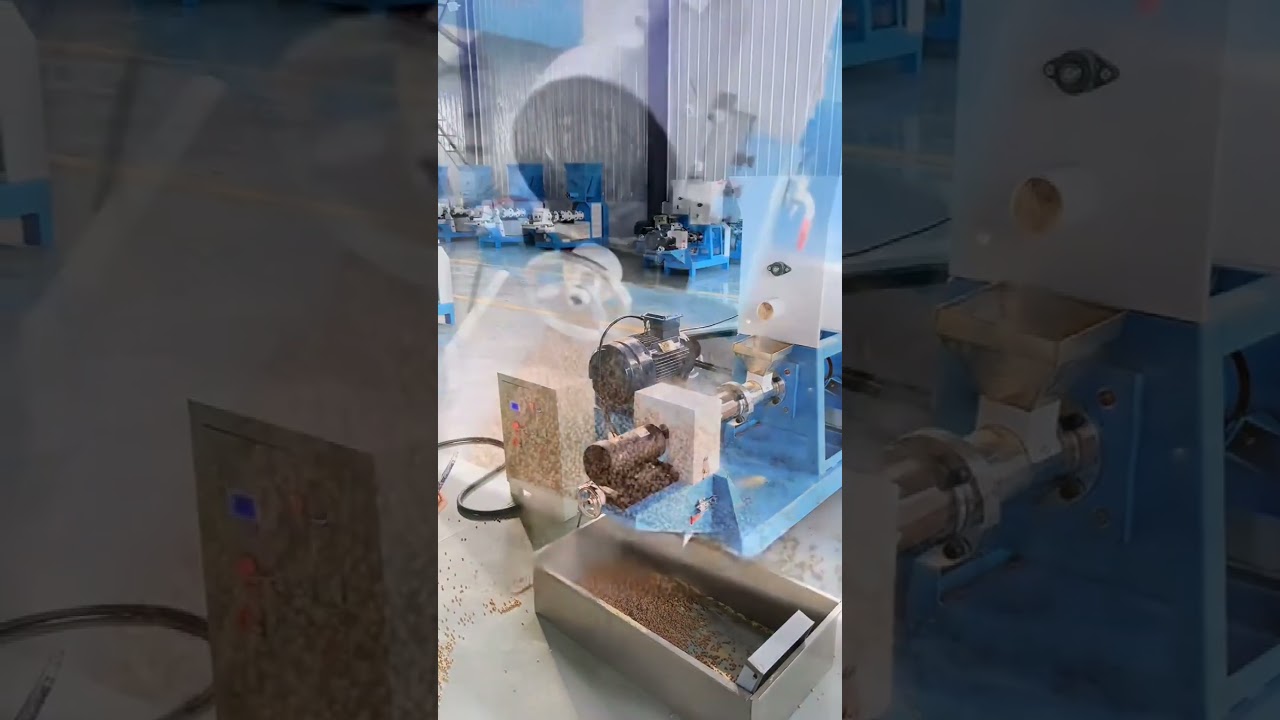

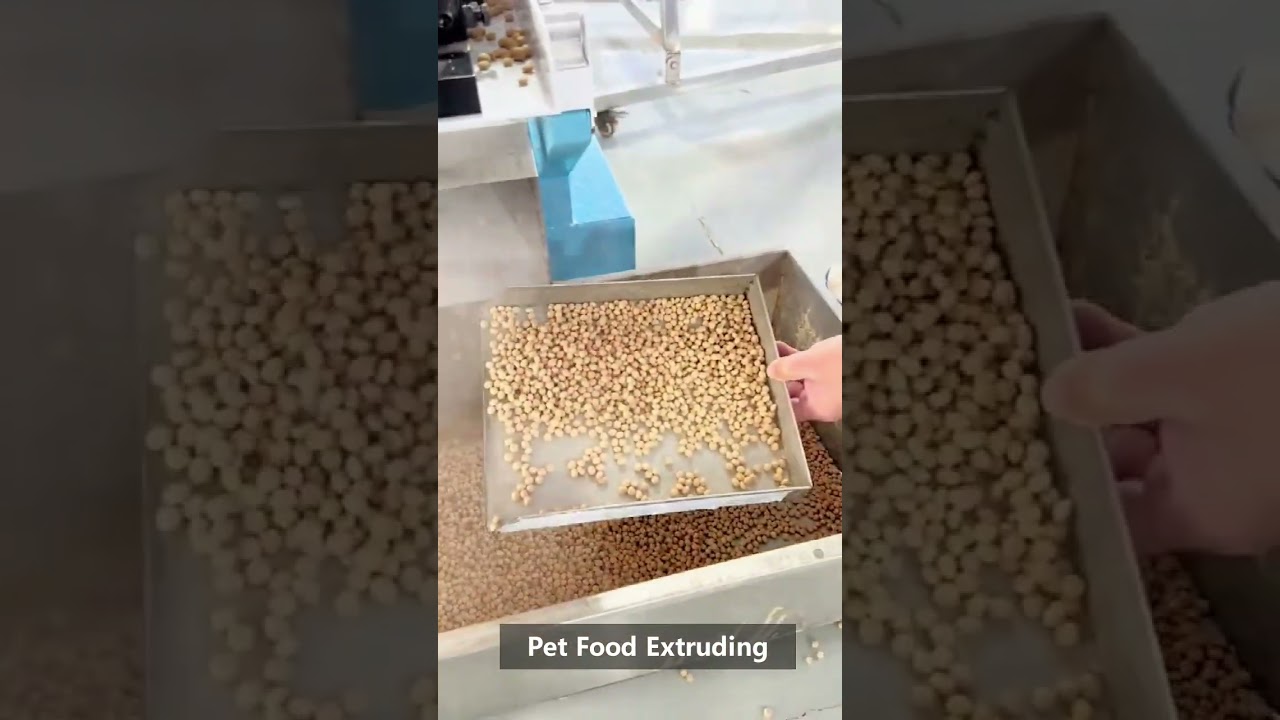
Shorts play vertically — tap through to YouTube for the full clip and more from the @PelletMachines channel.
Starting small does not mean starting limited
The DGP60 and DGP70 are the two most popular first machines: cheap enough to risk, capable enough to sell real product. Many customers run one for a season, prove the market, then add a wet type machine for volume.
Because the same barrel makes pet food, a dry type extruder can earn through the fish off-season. We supply both sets of formulas free — fish feed and dog and cat kibble — with the settings for each.
Step up when you have confirmed demand above about 1 T/H, or when customers start asking for pellet durability that only steam conditioning delivers. At that point the wet type extruder gives 30–60% more from the same footprint.

- No steam boiler — fewer permits, lower capital, faster start-up
- Floating feed with over 2 hours float time
- Pellet size 0.9–10 mm from fry feed to large pellets
- Pet food kibble from the same barrel with a different die
- Free floating, sinking and pet food formulas supplied
- Simple to operate — one person can run the whole machine
Dry Type vs Wet Type Extruder: The Difference
Both make floating feed. The difference is capacity, capital and what you can put in the formula.
| Item | Dry type extruder (this page) | Wet type extruder |
|---|---|---|
| Steam boiler | Not required | Required |
| Capacity, same model | Base figure | 30–60% higher |
| Cooking method | Barrel friction only | Steam pre-conditioning plus friction |
| Pellet durability | Good | Better; fewer fines |
| Fat tolerance in formula | Up to about 10% | Up to 20%+ with vacuum coating |
| Barrel and screw wear | Higher — runs hotter | Lower |
| Purchase price | Lower | About 15–25% higher |
| Operating skill | Simpler | Needs steam management |
| Best for | Startups, no boiler, pilot plants | Commercial plants, export-grade, high capacity |
Full wet type specifications are on the wet type fish feed extruder page.
Dry Type Extruder Wear Parts: Hours and Cost
A dry type extruder wears faster than a wet type, because no steam softens and lubricates the mash. Four parts carry that wear: the screw, the barrel sleeve, the die and the cutter blades. Bearings and the drive coupling come after them.
Plan on cutter blades needing attention every few hundred hours — resharpening first, replacement later. A die is good for roughly 1,000–2,000 hours of floating feed. Screw and barrel sleeve run 2,000–4,000 hours. These are planning ranges, not guarantees: abrasive raw material, over-fine grinding and running the barrel hot all push you to the low end.
Wear shows up before it stops you. Output falls at unchanged settings. Motor current climbs for the same tonnage. Pellet surface turns rough and fines go up. Cutter blades past their edge give ragged pellets and put extra load on the die.
If the die blocks, do not stop the screw with a full barrel — the mash sets and you will spend a shift clearing it. Stop the feeder, keep the screw turning at low speed and let the barrel empty itself, then clear the die holes from the outside with a soft tool. Never hammer a die.
Most of this is prevented, not repaired. Check the cutter blade gap every shift, because it drifts. Clean the magnet at the mash inlet daily — a bolt end costs you a screw. And record motor current at fixed settings once a week: that one number is your wear gauge.
Wear parts ship from stock, and we hold the drawings for every model we have built. Ask for the wear part list for your model.

Running It With One Person
One person can run a dry type extruder, and most of our customers do. The trick is sequence. Start the cutter, start the screw at low speed, then start the feeder — and bring speed up only once feed is coming through the die. Shut down in the reverse order: feeder off, barrel run empty, then stop.
Three checks tell you it is running right. Look at the die face: feed should come out evenly across every hole, with no surging. Listen: a steady note, no knocking, no squealing. Watch the ammeter: the needle should sit still at your set speed, not climb.
Almost every service call we get traces back to one of three mistakes. Running the barrel starved and then dumping feed in, which surges and blocks. Adding water at the extruder to soften the mash — moisture is set at the mixer, and extra water here gives soft pellets and a blocked die. And stopping with a full barrel, which sets the feed solid in the die.
Learn the sound of your machine at its best setting. That is the reference you will actually use, long after the manual is lost. When a single machine is no longer enough, the next step is a complete fish feed production line built around the same barrel.
If you need the 30–60% capacity gain that steam conditioning gives, that is the wet type fish feed extruder — same principle, different barrel.
Dry Type Fish Feed Extruder Questions
How much does a dry type fish feed extruder cost?
Do I really not need a boiler?
Can it make floating feed?
Can it make sinking feed too?
What else do I need besides the extruder?
How long do the barrel and screw last?
Can I make dog and cat food?
When should I upgrade to wet type?
Ask for a dry type extruder recommendation
Send the species, target kg/h, floating or sinking, and your power supply. You get a model, die set and landed budget within 12 hours. Send the details to info@pelletmachines.net or WhatsApp +86 186 0385 1787 — engineers reply within 12 hours.
Extruders, Lines and Aquatic Equipment
- Wet Type Fish Feed Extruder
- Fish Feed Pellet Machine (full range)
- Fish Feed Pellet Production Line
- Ultra Fine Feed Hammer Mill
- Double Paddle Feed Mixer
- Feed Pellet Coating Machine
- Counterflow Pellet Cooler
- Rotary Grading Sieve
- Weighing & Packing System
- Ring Die Aquatic Feed Pellet Mill
- 5 Sets Extruder to Ghana
- DGP70 Wet Line to Nigeria
Start Producing Floating Feed Without a Boiler
Send the species and target kg/h. You get a model recommendation, die set, free formulas and an investment range within 12 hours.


