

Feed Pellet Weighing & Packaging System Accurate Bagging at Line Speed
Giving away product in every bag is a quiet, permanent cost. This system weighs 20–50 kg bags at 360–540 bags per hour with ±0.2% dynamic accuracy, then closes and conveys them — so the weight on the label is the weight in the bag.
Reference FOB price: USD 3,200 – 9,500 by configuration. Bag closing and conveyor options matched to your line.

The Last Stage — and the One That Decides Whether You Give Product Away
Packing accuracy is a direct margin issue. At ±0.2% on a 40 kg bag you lose 80 grams; at hand-filling tolerance of ±1% you lose 400 grams. Across a year of production that difference is a meaningful amount of money.
± 0.2% dynamic
Two-speed filling — fast to near target, then dribble to exact weight.
360–540 bags/h
Keeps up with lines up to about 20 t/h at 40 kg bags.
Sewing or heat seal
Options for woven PP bags, paper bags and PE film.
Cleaner packing area
Dust collection at the filling spout improves the working environment.
Four Assemblies, One Machine
Every packing system we build is the same four assemblies in the same order. What changes between plants is their size, and how the bag is closed.
Weighing, conveying, closing, controlling
The weighing assembly is a buffer hopper, a two-stage gate and a load-cell frame. Product falls into the bag under its own weight — there is no screw feeder and no pneumatic line — so the load cells only have to measure what has already arrived.
The conveyor takes the filled bag from the spout to the closing head and on to the pallet. Its length follows your floor, not the machine.
The closing assembly is a sewing head, a heat sealer or a paper folder, chosen for the bag you actually buy. The control cabinet sequences all of it and holds the weight recipe.
Because the four parts are separate, any one of them can be changed later: a longer conveyor, a different closer, a second weighing head.

Weighing assembly
Buffer hopper, two-stage gate and load cells. Gravity does the feeding; the cells only weigh.
Conveying assembly
Flat belt from the spout to the closer and on to palletising, cut to your floor layout.
Bag closing assembly
Sewing head for woven PP and paper, heat sealer for PE film, folder for pasted paper.
Computer control
PLC cabinet holding the weight recipe, bag count and fault display. One operator, one button.
Weighing & Packaging System Specifications
Standard configuration below. Bag closing method, conveyor length and dust collection are set to your line and bag type.
| Parameter | Value | What it means |
|---|---|---|
| Model | SDBY50 | Standard platform for 20–50 kg bags |
| Rated weighing | 20–50 kg | Covers standard feed bag sizes |
| Weighing speed | 360–540 bags/h at 40 kg/bag | Matches lines up to about 20 t/h |
| Display resolution | 10 g | Fine resolution for accurate target setting |
| Static accuracy | ≤ ± 0.1% | Accuracy when the scale is at rest |
| Dynamic accuracy | ≤ ± 0.2% | Accuracy during actual filling — the number that matters |
| Air supply | Pressure 0.4–0.6 MPa, consumption 0.5 m³/h | Pneumatic gate and bag clamp |
| Power supply | 380V / 50Hz, 3 kW | Three-phase standard; built to your local supply |
| Installation height | 3,730 mm | Headroom required above the packing floor |
| Temperature range | -10 to 40 °C | Standard operating range |
Two-speed filling — bulk fill then dribble — is what delivers ±0.2% dynamic accuracy at speed.
What accuracy is worth
On a 40 kg bag, ±0.2% is 80 grams. Hand filling or a poorly maintained scale commonly runs at ±1%, which is 400 grams given away on every bag.
At 400 bags per hour over a single shift, that difference is roughly 1.3 tons of product per day.
What you need at your site
- Headroom: 3,730 mm installation height.
- Compressed air: 0.4–0.6 MPa, 0.5 m³/h.
- Power: 380V/50Hz three-phase, 3 kW.
- Ambient temperature between -10 and 40 °C.
- One operator to place and remove bags.
Quick quote — packing system configuration
Tell us your bag size, target bags per hour and bag type. We reply with the configuration and landed price. Send the details to info@pelletmachines.net or WhatsApp +86 186 0385 1787 — engineers reply within 12 hours.
Two-Speed Filling Is What Delivers Speed and Accuracy
Filling fast the whole way is quick but inaccurate; filling slowly the whole way is accurate but slow. Two-speed filling gives both.
Bag placement
Operator places an empty bag on the filling spout; the clamp holds it.
Bulk filling
The gate opens fully and product flows at high rate to near the target weight.
Dribble filling
The gate throttles to a fine stream and tops up to the exact target.
Release
The clamp releases and the filled bag moves to the closing station.
Closing & conveying
Bag is sewn or heat sealed, then conveyed to palletising or storage.

Showroom — packing systems in complete feed plants
See the packing system at the end of a full production line.
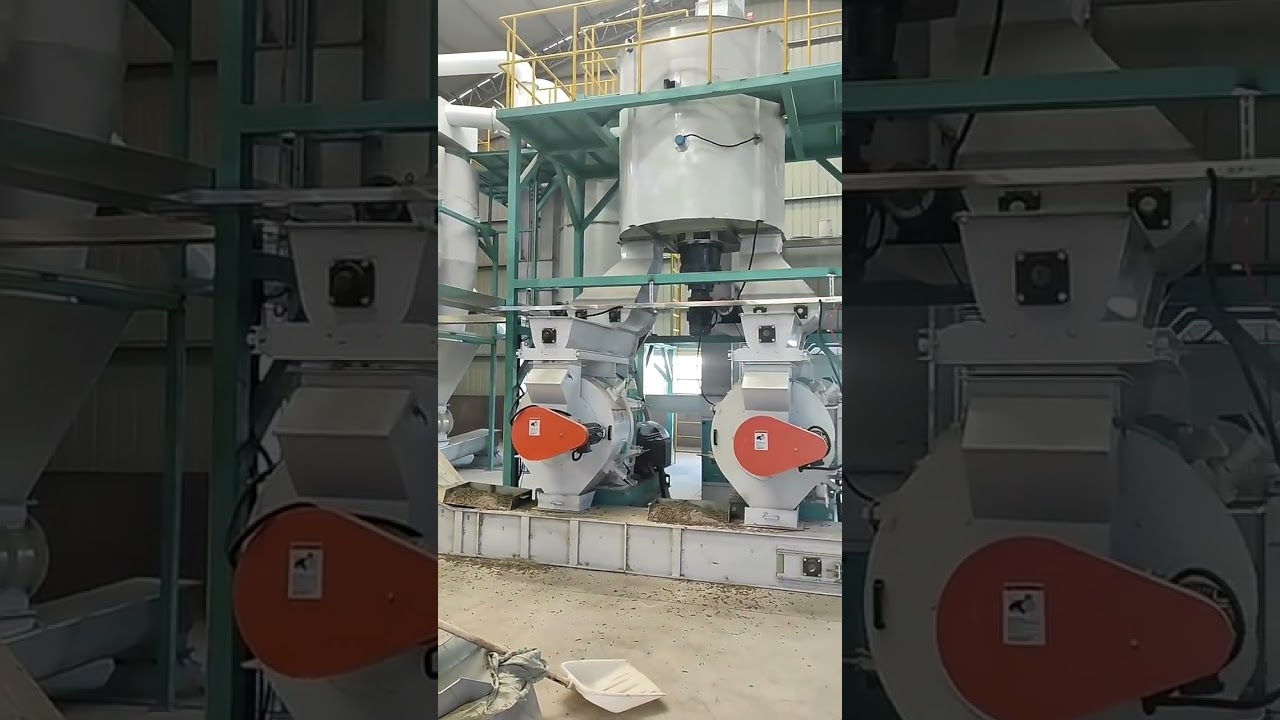
4 TPH ruminant animal feed pellet plant
A working plant where lines of this throughput are bagged at speed.
Single Head or Twin Head
One weighing head fills one bag at a time. Two heads on one frame fill two, share a conveyor and a closer, and cost far less than two separate stations.


When a second head pays for itself
A single head at 360–540 bags an hour covers lines up to about 20 t/h at 40 kg bags. Above that the operator becomes the bottleneck before the scale does.
The twin-head version puts a second hopper, gate and load cell on the same frame and the same conveyor. Output roughly doubles for a fraction of the cost of a second station, and one operator can keep both spouts fed.
If you pack more than one product, two single heads are often the better answer — each can run its own recipe without a changeover.
Which Bag Type and Which Closing Method
Bag choice depends on your market, storage conditions and how the feed is handled after it leaves you.
| Bag type | Closing method | Best for | Notes |
|---|---|---|---|
| Woven PP bag | Sewing | Most markets; strong and cheap | Most common choice for animal feed |
| Woven PP with liner | Sewing + inner liner | Humid climates, long storage | Liner protects against moisture |
| Multi-wall paper bag | Sewing or pasted | Premium and retail feed | Better print quality |
| PE film bag | Heat sealing | Moisture-critical products | Best moisture barrier |
| Bulk bag (FIBC) | Spout tie-off | 500–1,000 kg bulk supply | For large farms and integrators |
We supply the closing equipment matched to your bag type. Dust collection at the filling spout is recommended for all configurations.
What It Packs
Anything that flows can be weighed and bagged on this platform. Feed pellets are our main use; the same machine runs fertiliser, plastic pellets, seed, grain and chemical raw material.
Animal feed pellets
2–8 mm pellets straight from the cooler, 20–50 kg woven PP bags, sewn closed.
Fertiliser granules
Urea, NPK and organic granules. Liner bags where the climate is humid.
Plastic pellets
PE, PP and PVC compound, heat-sealed into PE film bags.
Seed and grain
Maize, wheat and soybean — drop height set low so germination is not damaged.
Chemical raw material
Powder and granule, with dust collection at the filling spout.
Wood pellets
Heating fuel in 15 kg retail bags, or 500–1,000 kg bulk bags by spout tie-off.


Beyond accuracy: what packing does for the product
A properly closed bag protects the feed on the journey to the customer. Poor closure lets moisture in, and moisture is what turns good pellets into mould within weeks.
Consistent, well-presented bags also sell. Feed is a repeat purchase, and a bag that arrives split or underweight is a customer lost on the next order.
Dust collection at the spout is worth specifying. It keeps the packing area breathable, reduces product loss, and cuts the dust that otherwise settles on everything in the building.

- Two-speed filling delivers speed and ±0.2% accuracy together
- 360–540 bags per hour — keeps up with lines to 20 t/h
- Bag closing matched to woven PP, paper, PE or bulk bags
- 10 g display resolution for precise target setting
- Dust collection at the filling spout
- Built to your local voltage and frequency
Packing Systems Assembled and Tested
Weighing hoppers, sewers and conveyors calibrated to ±0.2% before dispatch — bring your bags, we run your product.


Feed Pellet Weighing & Packaging System Questions
How much does a weighing and packing system cost?
How accurate is it?
How many bags per hour?
What bag sizes does it handle?
What bag types can it close?
What utilities do I need?
Can it be added to an existing line?
What is the warranty and support?
Ask for a packing system proposal
Send your bag size, target bags per hour and bag type. You get the configuration and investment range within 12 hours. Send the details to info@pelletmachines.net or WhatsApp +86 186 0385 1787 — engineers reply within 12 hours.
Packing, Batching and Control Equipment
- Automatic Batching System
- PLC Control System
- Rotary Grading Sieve
- Vibrating Grading Sieve
- Counterflow Pellet Cooler
- Feed Pellet Crumbler
- Ring Die Feed Pellet Mill
- Feed Pellet Production Line
- Fish Feed Pellet Production Line
- Plant Installed in Bangladesh
- Pellet Mill to Pakistan
- Hammer Mills to Palestine
Stop Giving Product Away in Every Bag
Send your bag size, target bags per hour and bag type. You get the configuration and investment range within 12 hours.


