

Vertical Ring Die Pellet MillHML series · 1–3.5 t/h · grass, straw, hay and sawdust
A ring die that stands upright and never turns, with the rollers orbiting inside it. Centrifugal force throws the material outward onto the die wall, so light, fibrous grass and straw are pressed across the whole die face instead of balling up in the middle. Stainless steel die chamber, because grass arrives wet.
- Three models — HML-560, HML-600, HML-700 — 90 to 160 kW, 1.0 to 3.5 t/h
- Stationary vertical die, rotating rollers: nothing bridges, nothing starves the nip
- Stainless steel body, double-layer ring die, cover off in two clamps for a die change
Reference FOB USD 9,500 – 26,000 by model · model selection, layout drawing and budget range back within 12 hours.

The mechanism
The die stands still.
The rollers do the work.
Every other ring die mill on the market turns the die and lets the rollers idle. This one does the opposite, and that single change is why it can hold capacity on material a horizontal mill cannot.
In a horizontal ring die mill the die rotates and drags the mash into the nip between die and roller. Feed it something light and fibrous — chopped grass at 120 kg/m³ — and the material bridges above the feed throat, or reaches the die unevenly and the mill surges from 1.4 to 0.9 t/h without anything actually being wrong.
Here the die is a vertical ring that never moves. Rollers orbit inside it on a central shaft. Material falls straight down into an open die chamber and the rotating rollers throw it outward; centrifugal force does the feeding, and it does it evenly around all 360° of the die.
Grass does not need steam and it does not need a conditioner. It needs pressure, a long die, and the whole die face working at once.
-
Nothing can bridge
No narrow throat, no screw forcing material into a nip. Grass, straw and sawdust drop into an open chamber, so the mill cannot arch over or starve.
-
The full die face wears evenly
Material is distributed by throw rather than by gravity, so the die wears as a ring instead of a band. Even wear is capacity — you are using every hole you paid for.
-
The die chamber runs cooler
A vertical ring stands in open air with its wall exposed. Compression heat leaves with the pellet instead of soaking into a horizontal die and its main bearing.
-
What it costs you
The machine is tall: plan a mezzanine, or a pit for the feeding conveyor. A die change means lifting the top cover. For grass and biomass that is a fair trade — for 20 t/h poultry feed it is not, and we will tell you so before you order.

Complete Grass Pellet Production Line Ruminant Feed Pellet Line Based on Vertical Ring Die Pellet Mill
Applications
Bought for grass and forage first
This is a biomass mill that also makes feed, or a feed mill that also makes fuel — the machine does not care. What changes is the die: hole size and compression ratio are cut for the material you actually run.
6–8 mm
Grass & forage pellets
Alfalfa, grass hay, oat hay and straw blends for cattle, sheep, horses and camels. No steam; molasses, urea and minerals go in at the mixer.
8–10 mm
Straw & stover roughage
Wheat straw, corn stover, peanut vine, bean stalk. Long fibre and low lignin — the case where a flat die loses half its rated capacity.
4–8 mm
Ruminant compound feed
Ground and mixed rations with a high fibre share. For high-starch poultry feed a horizontal ring die with a conditioner is the better buy, and we say so.
6–12 mm
Wood & biomass fuel
Sawdust, shavings, rice husk, palm fibre, bagasse. 600–700 kg/m³ out of the die, on the same mill and the same die seat.
Core components
Specified around the die change and the wet season
Two things ruin this machine in the field: a body that rusts from wet grass, and a die that takes a shift to change. Both are designed out.

-
Stainless steel body
Upper body, die cover and discharge chute in 304 stainless. Wet grass, molasses and silage seep into every seam; painted steel rusts there inside a season. Stainless does not, and it washes down.
-
Double-layer ring die
Holes run through both faces of the ring. When one face is worn you flip the die and run the second, roughly doubling die life. Compression ratio is cut to your material: 1:8–1:10 for grass, 1:5–1:6 for sawdust.
-
Two-clamp die cover
Toggle clamps release the cover and the die is a slip fit on its seat. Two people change a die in about twenty minutes, not a shift.
-
Orbiting roller assembly
Rollers on a central shaft with eccentric gap adjustment. Throw does the feeding, so there is no forced feeder to choke on a wet batch.
-
Gear drive, oil bath
Hardened helical gears running in oil with a circulation pump and cooler. Measured transmission efficiency above 98%, and no belts to re-tension.
-
VFD feeder
Screw or belt feeder trimmed against main motor current: a wet batch slows the feed instead of tripping the mill.
Video
Eight clips, no stock footage
Two long ones — the mill running inside a grass line, and an HML-560 on pine sawdust — then six short test runs on straw, palm fibre and rice husk.


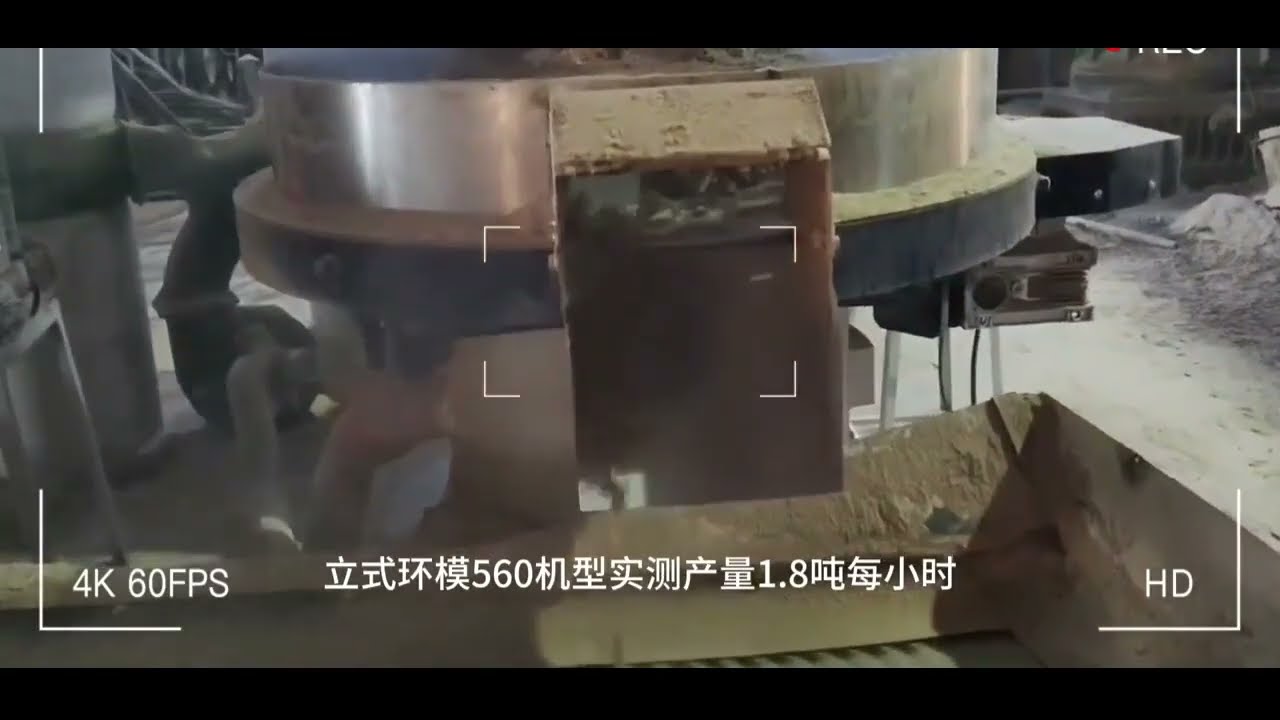


More clips on our YouTube channel. Running the grass line itself? The grass pellet production line page walks the whole flow from bale to bag.
Technical data
HML-series models and capacity
Three models cover 1.0–3.5 t/h on grass. Figures are factory-tested on chopped grass hay at 12–16% moisture.
| Model | Main motor | Capacity | Die inner Ø | Pellet Ø | Dimensions L×W×H | Weight |
|---|---|---|---|---|---|---|
| HML-560 | 90 kW | 1.0–1.5 t/h | 560 mm | 4–12 mm | 2100×1200×1890 mm | 5.8 t |
| HML-600 | 132 kW | 1.5–2.3 t/h | 600 mm | 4–12 mm | 2220×1200×1800 mm | 6.8 t |
| HML-700 | 160 kW | 2.3–3.5 t/h | 700 mm | 4–12 mm | 2400×1400×2100 mm | 7.5 t |
Capacity is a material figure, not a motor figure. Sawdust and rice husk usually run 10–20% higher by weight; long wheat straw about 10% lower. We confirm the guaranteed output against your material and put that number in the contract.
Which model for which job
| You are making | Pellet Ø | Recommended | Why |
|---|---|---|---|
| Alfalfa or grass hay for cattle and sheep | 6–8 mm | HML-560 | 1–1.5 t/h matches a 200–400 head herd on one shift |
| Straw-heavy ruminant ration | 8–10 mm | HML-600 | Long fibre needs the bigger die face to hold rate |
| Sawdust and wood shavings | 6–8 mm | HML-600 / 700 | 1.5–3 t/h on dry sawdust, 600–700 kg/m³ |
| Rice husk, palm fibre, bagasse | 8–10 mm | HML-700 | Abrasive, high-silica material — the 700 wears better per tonne |
Complete line
What has to sit either side of it
A vertical ring die mill is one stage of a line. These are the machines we normally quote with it — and where you already own one, we integrate rather than replace.
Built here
Assembled, wired and run before it is crated
Every unit is built in our own workshop in Zhengzhou, run under load with your order number in frame, then crated. You see the machine working before it leaves, not after it arrives.

Questions
Vertical ring die pellet mill FAQ
What is a vertical ring die pellet mill?
A ring die mill where the die is a vertical ring that stays still while the rollers orbit inside it. Material falls in from above and centrifugal force presses it against the die wall. It is the layout used for light, fibrous material — grass, straw, hay, sawdust — where a horizontal mill struggles to feed evenly.
Vertical or horizontal ring die — which should I buy?
If your material is grass, straw, hay or sawdust, the vertical die holds capacity better and is far more forgiving of light, fluffy feed. If you are making high-starch compound feed at 5 t/h and above, a horizontal ring die with a steam conditioner gives a better pellet and a higher rate. We build both and will point you at the right one.
Can it make animal feed, or only wood pellets?
Both. Grass, alfalfa, hay and straw rations for cattle, sheep, horses and camels are the main use; sawdust, rice husk, palm fibre and bagasse run on the same machine with a different die. What changes is die hole size and compression ratio, not the mill.
What capacity will I really get on grass?
HML-560 about 1.0–1.5 t/h, HML-600 1.5–2.3 t/h, HML-700 2.3–3.5 t/h on chopped grass hay at 12–16% moisture. Material length, moisture and how well the chopper has cut all move that figure by 10–20%. Send a sample and we will run it and give you a measured number.
How much does a vertical ring die pellet mill cost?
Reference FOB: HML-560 around USD 9,500–14,000, HML-600 around USD 14,000–19,000, HML-700 around USD 19,000–26,000. Die configuration, motor brand, voltage and whether you take the feeder and conveyor as a set all move the price. A complete 1–3 t/h grass line runs USD 28,000–95,000.
What moisture does the material need?
12–16% for grass and straw, 10–15% for sawdust. Below 12% the pellet crumbles; above 17% the die blinds and the mill loads up. If your grass is fresh-cut at 25–30%, it needs wilting or drying first — we will tell you which, based on your climate.
Do I need a steam boiler?
No. This mill pellets grass and biomass on pressure and natural moisture alone. Steam conditioning is a feed-mill feature for starch gelatinisation; for forage and biomass it adds cost without adding pellet quality.
What about dies, rollers and spare parts?
Dies and rollers are held in stock for dispatch rather than made to order — the difference between a two-day repair and a two-month one. A double-layer die gives two working faces, so one spare covers twice the hours.
What power supply does it need?
Three-phase 380 V / 50 Hz as standard, or 415 V / 60 Hz and other voltages to order. HML-560 needs a 90 kW motor, so plan a supply with headroom for the feeder, conveyors and cooler — typically 110–120 kVA for a single-mill line.
Next step
Send the material, get a model and a budget
Tell us what you are pelleting, the tonnage per hour you need and your local voltage. That is enough for us to recommend a model, cut a die for your material and give you an investment range — within 12 hours.
- Emailinfo@pelletmachines.net
- WhatsApp+86 186 0385 1787
- LineGrass pellet production line — bale to bag
Engineers answer directly — no call centre, no reseller in between.
Request model, price & die spec
No forms to download. Describe the material and we do the sizing.


