

Fish Feed Pellet Machine
Extruder for Floating Fish Feed and Pet Food
A fish feed pellet machine works by extrusion: it cooks the mash under heat and pressure, then releases it to atmospheric pressure — the sudden pressure drop makes the pellet expand and float. The same machine also produces slow-sinking and sinking feed by changing screw configuration and die, and it makes pet food on the same barrel.
Reference FOB price: USD 2,200 – 32,000 by model, dry or wet configuration. Free feed formulas supplied with every order.

Extruder or Ring Die? How to Choose
Two machines make aquatic feed, and they are not interchangeable. An extruder cooks the mash under pressure and releases it into open air, so the pellet puffs. A ring die aquatic feed pellet mill presses mash through a die with rollers, and the pellet comes out dense.
The names do not help you here. Suppliers use “fish feed pellet machine” for both an extruder and a ring die press, so ask what the machine makes rather than what it is called.
That single difference decides your product list. Extrusion is the only route to floating feed. A ring die mill makes sinking feed, and makes it cheaply. It uses less energy per tonne, needs lower capital per tonne of capacity, and produces a harder pellet that survives bulk handling.
Size range splits the other way. An extruder reaches 0.9 mm for fry and runs to 10 mm. A ring die cannot go that fine, so if fry or fingerling feed is part of your market, the extruder is not optional.
Fat narrows it further. An extruder takes roughly 10% oil in the mash, and 20% or more when the oil goes on after extrusion in a vacuum coater. A ring die handles less before the pellet weakens, which is why high-energy marine and shrimp diets are normally extruded.
| Question | Extruder | Ring die mill |
|---|---|---|
| What it makes | Floating, slow-sinking, sinking, pet food | Sinking aquatic feed, denser pellet |
| Can it make feed float? | Yes — that is the whole point | No |
| Pellet size | 0.9–10 mm | Cannot reach 0.9 mm fry feed |
| Fat in the formula | About 10% in the mash; 20%+ after vacuum coating | Lower — most oil is added after pelleting |
| Energy per tonne | Higher | Lower |
| Cost per tonne of capacity | Higher | Lower |
| Operating skill | Needs an operator who reads current, sound and pellet surface | More forgiving |
| Choose it when | You need float, fine sizes, high fat or pet food | Your whole market is sinking feed at volume |
Buy the ring die first if every tonne you sell is sinking feed and the budget is tight. Buy the extruder first if you need float, fine sizes or high fat. The mistake we see most often is buying a ring die mill to save money, then finding the market wants floating feed.
Many producers end up with both: an extruder line for floating feed and pet food, a ring die line for tonnage. We build both types of fish feed pellet machine and quote them as one project, so the two lines share grinding and packing where it makes sense.
Still deciding? Tell us what you sell and to whom, and we will tell you which machine to buy first — not which one to buy. Send your product list.

Do You Need a Twin Screw Extruder?
Almost every fish feed extruder in this size range is single screw: one screw turning in a grooved barrel. That is what we supply, from the DGP50 dry type to the DSP200 wet type, and it covers floating, slow-sinking and sinking feed up to 10 mm.
The limits are fat and fineness. A single screw conveys the mash by friction, so it starts to slip when the mash is very oily or very fine. Above roughly 20% fat in the barrel, or for micro feed below about 1 mm at volume, throughput and pellet quality both fall away.
A twin screw uses two intermeshing screws that convey positively instead of by friction. It handles sticky, oily and very fine mash, and it cleans itself between formulas. It also costs far more than a single screw, and it needs a fitter who knows it.
The extra cost is worth it in three cases. You need more than about 20% oil in the mash itself, not sprayed on afterwards. Sub-1 mm feed is a main product, not a sideline. Or you change formula several times a day and cannot afford long clean-downs. If none of those apply, a single screw is the better buy.

One Barrel, Three Products: Floating, Slow-Sinking and Pet Food
The extruder is the only machine that can make feed float. It also gives you the widest pellet size range of any machine we build — 0.9 mm fry feed up to 10 mm pellets for large fish and dogs — and the ability to add high levels of fish oil that a ring die mill cannot handle.
0.9–10 mm
Tilapia, catfish, ornamental fish. Float time over 2 hours; farmers can see how much the fish eat.
1.5–8 mm
Shrimp, seabass, bottom feeders — set by screw and die configuration, not by a second machine.
2–10 mm
Dog and cat kibble on the same barrel with a different die and formula — a second revenue stream from one asset.
0.9–2 mm
Fry and fingerling feed; the fine end of the range that no pellet mill can reach.
Fish Feed Pellet Machine Models — 0.06–5 T/H, Dry and Wet
This series is supplied in two configurations. The dry type has no conditioner and is cheaper; the wet type adds a conditioner and produces higher capacity, better cooking and a more stable pellet. Both are listed below.
| Model (dry / wet) |
Dry type capacity (T/H) | Wet type capacity (T/H) | Main power (kW) | Feeder (kW) | Screw dia. (mm) | Cutter (kW) |
|---|---|---|---|---|---|---|
| DGP50 | 0.06–0.08 | — | 11 | 0.4 | 50 | 0.4 |
| DGP60 / DSP60 | 0.12–0.15 | 0.18–0.20 | 15 | 0.4 | 60 | 0.4 |
| DGP70 / DSP70 | 0.18–0.25 | 0.30–0.35 | 18.5 | 0.75 | 70 | 0.4 |
| DGP80 / DSP80 | 0.3–0.35 | 0.40–0.45 | 22 | 0.75 | 80 | 1.5 |
| DGP90 / DSP90 | 0.4–0.45 | 0.50–0.55 | 37 | 1.1 | 90 | 2.2 |
| DGP120 / DSP120 | 0.5–0.7 | 0.7–0.8 | 55 | 1.1 | 120 | 2.2 |
| DGP135 / DSP135 | 0.8–1.0 | 1.0–1.2 | 75 | 1.5 | 135 | 3.0 |
| DGP160 / DSP160 | 1.2–1.5 | 1.8–2.0 | 90 | 2.2 | 155 | 3.0 |
| DGP200 / DSP200 | 1.8–2.0 | 3.0–5.0 | 132 | 2.2 | 195 | 4.0 |
Dry type models carry the DGP prefix, wet type models the DSP prefix — the frame, screw diameter and motor are the same. Wet type adds a conditioner (0.37–5.5 kW by model) and a steam connection. The wet configuration typically adds 15–25%. Pellet size 0.9–10 mm by die change.
What decides floating vs sinking
Buoyancy is controlled by the pressure drop at the die and the starch and fat content of the formula. Higher temperature, higher pressure and lower fat give more expansion and better float. We supply the formulas and the screw configuration for each product.
Free formulas with every machine
- Floating tilapia and catfish feed formulas.
- Sinking shrimp and seabass formulas.
- Dog and cat kibble formulas for the pet food range.
- Temperature, moisture and screw speed settings for each.
Quick quote — extruder model, dry or wet
Tell us the species, target T/H and whether you want floating or sinking feed. We reply with the model, configuration and a landed budget. Send the details to info@pelletmachines.net or WhatsApp +86 186 0385 1787 — engineers reply within 12 hours.
Dry Type or Wet Type — The Decision That Sets Your Capacity
This is the first question to settle when buying a fish feed extruder. It changes the price, the capacity, the pellet quality and whether you need a boiler.
| Item | Dry type extruder | Wet type extruder |
|---|---|---|
| Conditioner | None | Jacketed conditioner with steam injection |
| Steam boiler | Not required | Required |
| Capacity (same model) | Lower — see table | 30–60% higher than dry |
| Cooking quality | Friction heat only | Steam pre-cooks mash; better gelatinisation |
| Pellet durability | Good | Better; less fines, higher water stability |
| Fat in formula | Up to about 10% | Up to 20% with vacuum coating |
| Purchase price | Lower | About 15–25% higher |
| Operating skill | Simpler to run | Needs steam management |
| Best for | Startups, small farms, no boiler available | Commercial plants, export-grade feed, high capacity |
If you already have or plan a boiler, the wet type pays back through capacity alone. If you are starting with no steam and a small budget, the dry type fish feed extruder gets you into production faster. Full wet-type data is on the wet type fish feed extruder page.
What a Tonne of Feed Costs to Run
Electricity is the largest cost you control per tonne, and the sum is simple. Divide the connected load by the output. A 55 kW main motor running at 0.6 t/h draws about 90 kWh per tonne. Add 5–10% for feeder, cutter and conveyors.
Cost per tonne = kWh per tonne × your local tariff. We quote the kWh figure and not a price, because tariffs vary by a factor of five across the markets we ship to.
Three settings move that number. Small die holes raise pressure and kWh per tonne, so 1 mm feed costs more to make than 4 mm. Wetter mash draws less power in the barrel but loads the dryer, which is the bigger bill. And more expansion burns more energy per tonne but makes a lighter pellet, so you sell more bags from the same tonne.
Ask for the kWh per tonne at your target pellet size before you compare two models. It is the only fair way to compare a 55 kW machine with a 75 kW one — and the same figure is what a fish feed production line is sized on.

How Extrusion Makes Fish Feed Float: 5 Steps
Five steps, and the third one is the whole trick. Understanding them explains why settings matter more than the machine brand.
- 1Grinding & mixing
Raw material ground below 0.5 mm and mixed to a precise formula; starch content drives expansion.
- 2Conditioning
Wet type: steam pre-cooks the mash to 80–90 °C. Dry type: friction in the barrel does the work.
- 3Extruding
The screw builds pressure up to 40 bar and 120–150 °C; starch gelatinises completely.
- 4Expanding
Mash exits the die into atmospheric pressure — dissolved water flashes to steam and the pellet puffs up.
- 5Drying & cooling
Pellets at 18–20% moisture and about 80 °C are dried to storage level, then cooled and packed.

Dry type fish feed extruder — working demonstration
Watch the dry type extruder produce floating feed without a steam boiler.

Wet type fish feed extruder — working video
The wet type with conditioner running at higher capacity and better pellet durability.
Extruders Running in Our Factory and in Customers’ Plants
Real clips — dry and wet extruders, complete fish feed lines and pet food production on the same platform.
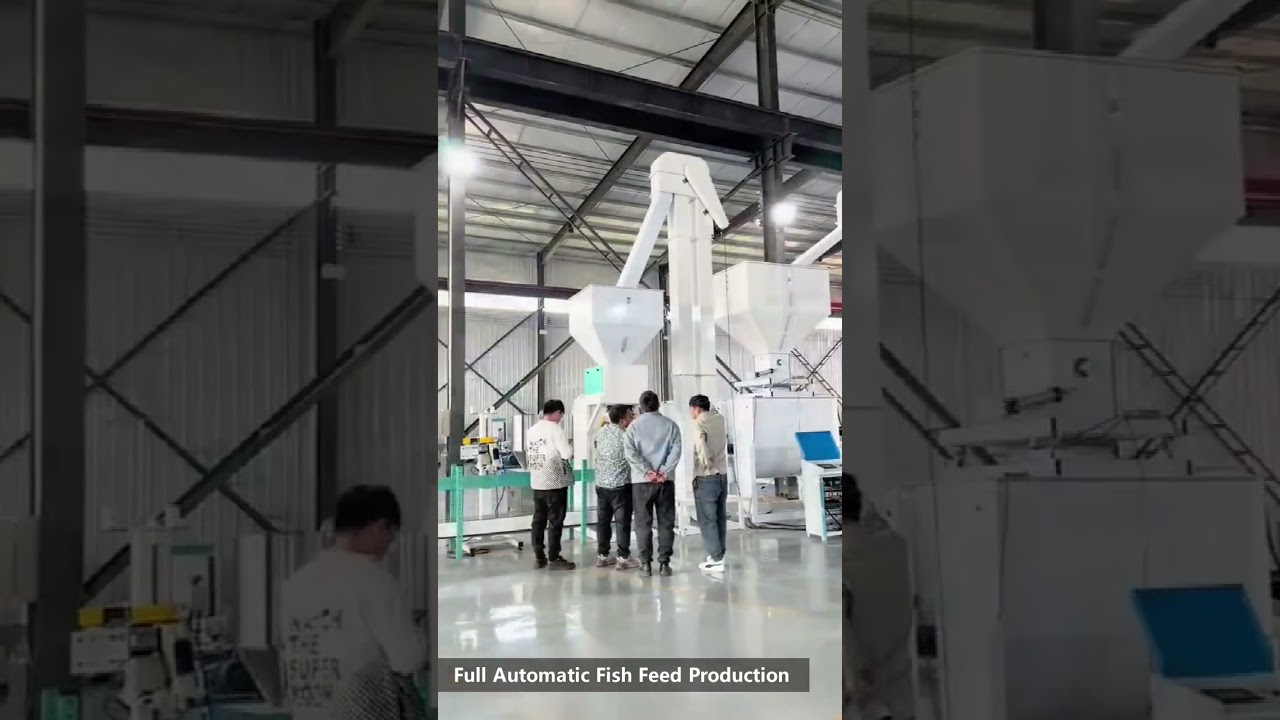

Shorts play vertically — tap through to YouTube for the full clip and more from the @PelletMachines channel.
One machine, two markets
Fish feed demand is seasonal in many markets; pet food is not. Because the same extruder barrel makes both, producers run fish feed in peak season and pet food kibble in the off-season — which is what turns a single-purpose machine into a year-round asset.
Pet food sells at a much higher margin per ton than commodity fish feed. The formula changes, the die changes, and the machine does not. We supply both sets of formulas with the machine at no extra cost.
The DGP85 configuration shown in the videos above is a common pet food setup. If pet food is your main target, tell us and we size the dryer and cooler for kibble rather than for fish feed.

- Floating feed with over 2 hours float time on water
- Pellet size 0.9–10 mm — from fry feed to large kibble
- Dry or wet configuration on the same platform
- Pet food and fish feed from one barrel, no second machine
- Free floating, sinking and pet food formulas with every order
- Formula and screw-setting support from our engineers
Raw Materials, Pellet Size and Moisture Specs
Extrusion is sensitive to formula. Below is the standard input list and the product specifications we design to.
| Item | Specification |
|---|---|
| Typical ingredients | Fish meal, fish oil, soy protein, wheat gluten, wheat and peas, minerals, vitamins, pigments, canthaxanthin |
| Pellet diameter | 0.9–10 mm by die change |
| Moisture before drying | 18–20% |
| Pellet temperature before cooling | About 80 °C |
| Float behaviour | Floating, slow-sinking or sinking by screw and die configuration |
| Water stability | ≥ 2 h for floating feed |
| Grinding fineness required | Below 0.5 mm |
| Downstream equipment | Dryer, oil coater, counterflow cooler, grading sieve, packing machine |
We supply the complete fish feed line — hammer mill, mixer, extruder, dryer, cooler and packing — sized as one balanced project.
Where to Start Your First Fish Feed Formula
Formulas are where first-time producers stall, so we supply them free with the machine — floating fish, sinking shrimp and pet food, with the temperature, moisture and screw speed for each. The table below is the shape of a starting formula, not a fixed recipe.
Every figure is an industry range. Your species, your raw material analysis and your die decide where inside the range you sit. Change one ingredient at a time and keep a log: expansion responds to starch, durability responds to protein and binder, and both respond to moisture.
| Ingredient | Typical inclusion | What it does |
|---|---|---|
| Fish meal | 20–50% | Main protein source, 60–65% protein; drives palatability and growth |
| Soybean meal / soy protein | 15–30% | Cheaper protein; balances the cost of fish meal |
| Wheat gluten | 3–8% | Protein plus binding; improves water stability |
| Wheat / wheat starch | 15–25% | Starch for gelatinisation — this is what makes the pellet expand and float |
| Fish oil | 4–8% in the mash | Energy; above about 10% it must go on after extrusion |
| Vitamin and mineral premix | 0.5–2% | Micronutrients and pigments such as canthaxanthin |
| Balance | remainder | Other meals, limestone, phosphate, mould inhibitor |
Ask for the formula set for your species — floating tilapia, catfish, sinking shrimp or kibble — with the machine settings that go with it. Free with every order. Request the formula pack.

Fish Feed Pellet Machine Questions
How much does a fish feed extruder cost?
Dry type or wet type — which should I buy?
Can one machine make both floating and sinking feed?
Can it make dog and cat food?
How long do the pellets float?
Do I need a dryer as well?
What is the smallest model for a startup?
Do you supply formulas?
Planning a floating feed or pet food line?
Tell us the species or pet food type, target T/H and whether you have a boiler. You get a model, configuration, full line list and budget within 12 hours. Send the details to info@pelletmachines.net or WhatsApp +86 186 0385 1787 — engineers reply within 12 hours.
Fish Feed and Aquatic Feed Equipment
- dry type extruder
- wet type extruder
- Fish Feed Pellet Production Line
- Ring Die Aquatic Feed Pellet Mill
- Ultra Fine Feed Hammer Mill
- Double Paddle Feed Mixer
- Feed Pellet Cooler
- Feed Pellet Coating Machine
- Automatic Batching System
- Rotary Grading Sieve
- 5 Sets Extruder to Ghana
- DGP70 Wet Line to Nigeria
Get Your Extruder Model, Configuration and Formulas
Since 2006 we have shipped fish feed extruders and pet food lines to more than 100 countries. Send the species, target tonnage and whether you have steam — you get a model, dry or wet recommendation, formulas and an investment range within 12 hours.


