

Electric Flat Die Feed Pellet Mill 80 to 1,200 kg/h for Farm and Small Plant
A flat die pellet mill presses mash downwards through a horizontal die plate while the rollers roll over it. Simple, visible and cheap to run, it is the right first pellet machine for a farm, a poultry house or a startup feed workshop — and the same machine also makes biomass fuel pellets from sawdust and crop stalks.
Reference FOB price: USD 700 – 6,500 by model. Model recommendation and die compression ratio matched to your raw material within 12 hours.

One Machine for Feed Pellets, Bedding Pellets and Biomass Fuel
The flat die design has no gearbox, no steam line and no complex control. You crush, you mix, you feed it in — pellets come out. That is why it stays the most widely sold small pellet machine in the world, and why many customers buy it first and add a ring die mill later.
Poultry & Rabbit Feed
Broiler, layer, duck, rabbit and pigeon feed from corn, wheat bran, soybean meal and rice husk.
Pig, Sheep & Cattle Feed
Grower and finisher feed; handles molasses and fibrous roughage with the right compression ratio.
Fish & Shrimp Feed
Sinking pellets 2–4 mm for pond farming; add steam conditioning for better water stability.
Biomass & Bedding Pellets
Sawdust, straw, peanut shell and cardboard — fuel pellets or animal bedding from the same machine.
Flat Die Feed Pellet Mill Specifications
Capacity is given for dry mash at 12–15% moisture with a 4 mm die. Sawdust and high-fibre material run at roughly half the feedstuff figure — that is normal for every flat die mill on the market.
| Model | Output (kg/h) | Motor power | Dimensions L×W×H (mm) | Weight (kg) |
|---|---|---|---|---|
| PM-150B | 80–120 | 4 kW | 800×350×670 | 95 / 110 |
| PM-200B | 200–300 | 7.5 kW | 1050×480×1000 | 200 / 230 |
| PM-260B | 400–600 | 15 kW | 1240×530×1070 | 320 / 360 |
| PM-300B | 600–800 | 22 kW | 1360×560×1160 | 410 / 450 |
| PM-400B | 800–1,200 | 30 kW | 1500×760×1210 | 660 / 700 |
| Model | Output (kg/h) | Engine power | Dimensions L×W×H (mm) | Weight (kg) |
|---|---|---|---|---|
| PM-150A | 80–120 | 10 hp | 950×600×800 | 165 / 190 |
| PM-200A | 200–300 | 15 hp | 1240×800×900 | 350 / 380 |
| PM-260A | 400–600 | 30 hp | 2000×770×1100 | 480 / 520 |
| PM-300A | 600–800 | 41 hp | 2300×700×1250 | 850 / 890 |
| PM-400A | 800–1,200 | 55 hp | 2300×700×1250 | 1050 / 1,100 |
Output is quoted for dry mash at 12–15% moisture with a 4 mm die; sawdust and high-fibre material run at roughly half that figure. Pellet diameter 2–8 mm by changing the die; length adjustable by knife position. Weight is given as net / gross (packed for export).
Which model fits you
- Under 300 kg/h — a household poultry or rabbit farm: PM-150B or PM-200B.
- 300–600 kg/h — selling feed to neighbours or a small commercial farm: PM-260B.
- 600–1,200 kg/h — a registered small feed workshop: PM-300B or PM-400B, paired with a hammer mill and a mixer.
- No grid power — the A series runs the same die on a 10–55 hp diesel engine.
Die compression ratio — the number that decides success
A flat die fails when the compression ratio does not match the material. Too low and pellets crumble; too high and the die blocks and the motor trips.
- Corn / soybean meal based poultry feed: 1:5 to 1:6.
- High-fibre ruminant and straw material: 1:4 to 1:5.
- Sawdust and woody biomass: 1:6 to 1:8, with binder adjustment.
We ship the die matched to the raw material you tell us about, not a default one.
Quick quote — model, die and price
Tell us the raw material, target kg/h and pellet size, and we come back with the right model, die compression ratio and a landed budget. Send the details to info@pelletmachines.net or WhatsApp +86 186 0385 1787 — engineers reply within 12 hours.
Ten Models on One Flat Die Platform
Every model shares the same die, roller and knife design. What changes is the die diameter, the motor size and the frame — so a spare die bought today still fits the machine you buy in five years.


A series — diesel engine drive
The same pelleting chamber, driven by a 10–55 hp diesel engine instead of an electric motor. For farms with no reliable three-phase supply, or for a site that moves between locations.


How the Flat Die Mill Forms a Pellet
There are only four moving parts in the pelleting chamber. That is the whole reason this machine is cheap to buy, cheap to fix and easy for one operator to run.
Feeding
Dry mash drops by gravity from the hopper into the pelleting chamber between the rollers and the die plate.
Pressing
Two or three rollers rotate over the flat die and squeeze the mash into the die holes under high pressure.
Extruding
Friction heats the mash to 60–80 °C, softening natural starch and lignin so the pellet binds.
Cutting
A knife under the die cuts the extruded strands; knife height sets pellet length.
Cooling
Pellets leave hot and soft — spread them or run a cooler before bagging, otherwise they mould in storage.


Small flat die pellet production line in operation
Watch a complete small flat die line: crushing, mixing, pelleting and cooling in one compact layout.

Richentek showroom — flat die and ring die machines side by side
See the flat die mill next to larger ring die machines so you can judge which scale fits your budget.
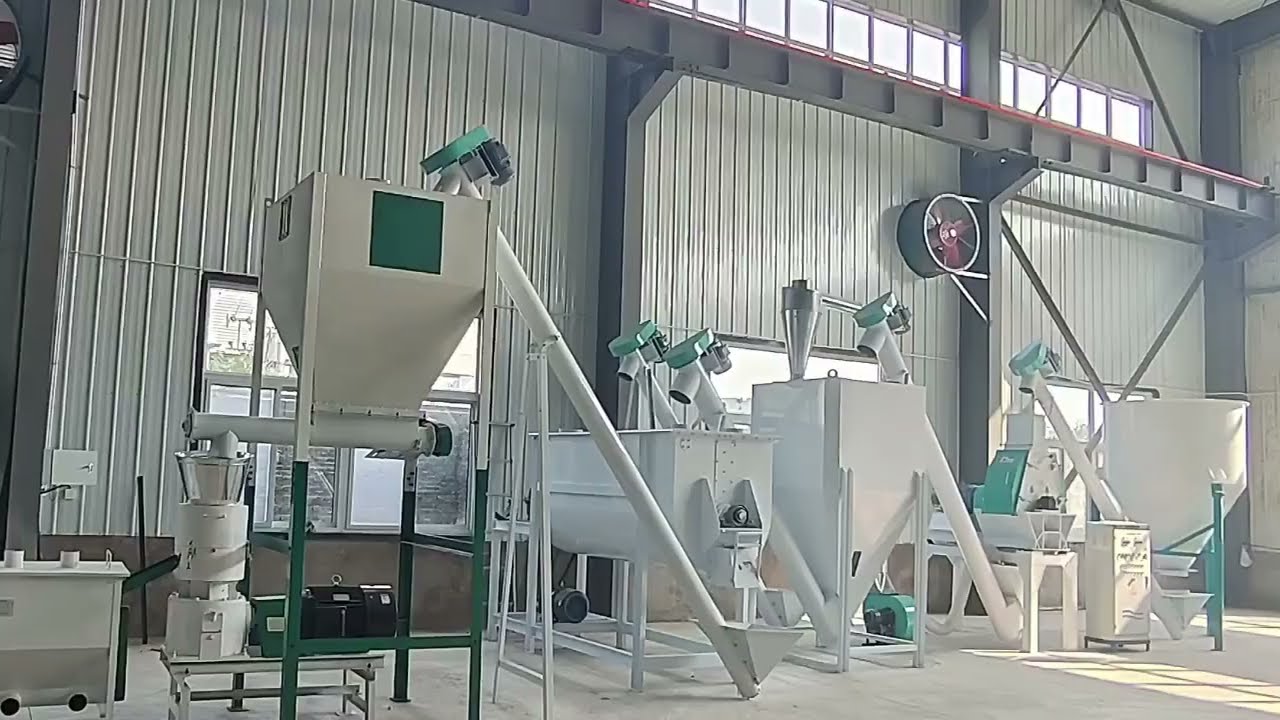
Our Feed Pellet Production Lines
A complete line running as one matched set — crusher, mixer, pellet mill and cooler.
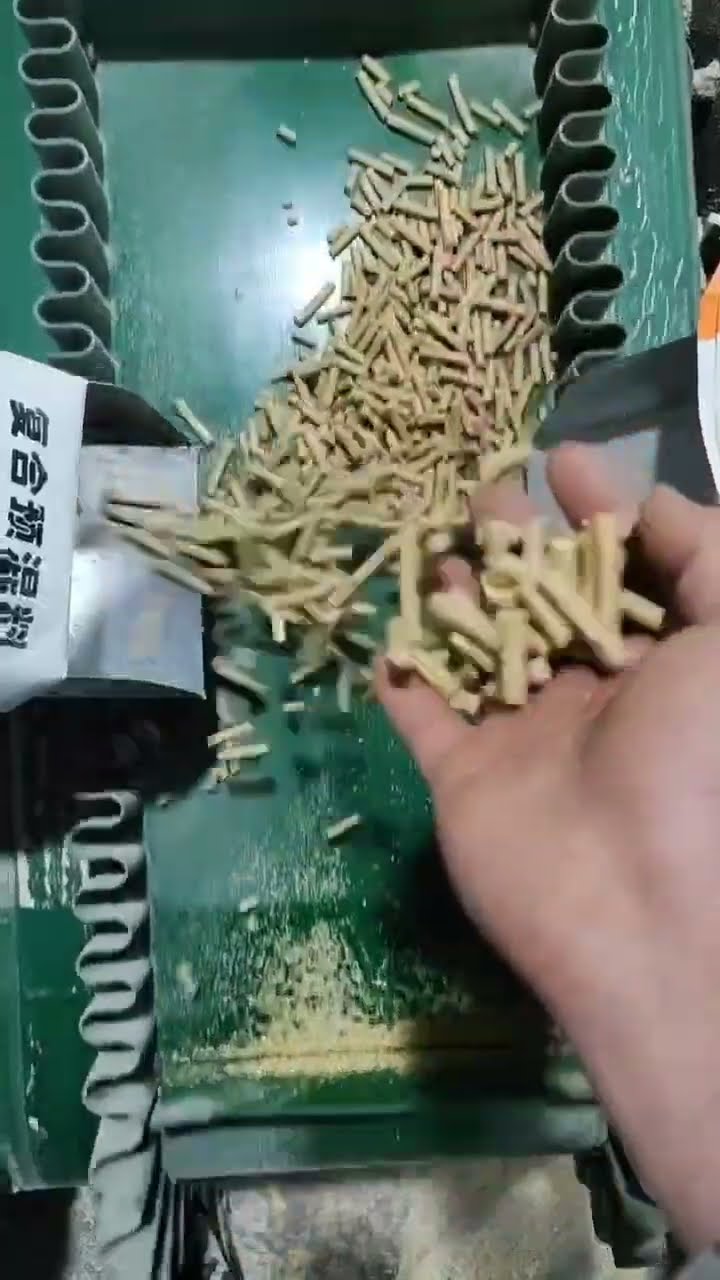
Pellets Straight Off the Flat Die Line
Fresh pellets on the discharge belt — length, hardness and fines checked before the bag.
Should You Start With a Flat Die Mill or Go Straight to a Ring Die?
This is the single most common question we get. The honest answer depends on three numbers: your target output per hour, how many hours you run per day, and who buys the pellets.
| Item | Flat die pellet mill (this page) | Ring die pellet mill (HM) |
|---|---|---|
| Practical output | 80–1,200 kg/h | 2–20 T/H per unit |
| Running hours | 6–8 h/day | 20–24 h/day continuous |
| Steam conditioning | Not required | Required for best quality |
| Pellet density & finish | Medium; more fines, rougher surface | High; smooth, uniform, low fines |
| Water stability (aquatic) | 10–20 min | ≥ 20 min with multi-layer conditioner |
| Die & roller cost | Low; cheap to replace | Higher; longer service life |
| Investment | USD 700 – 6,500 | USD 12,000 – 52,000 |
| Typical buyer | Farm, startup, trial production | Commercial feed mill, integrator |
Rule of thumb: below 500 kg/h and running a few hours a day, a flat die mill pays back fastest. Above 1–2 T/H, or if you sell to commercial farms, only a ring die mill gives the density and uptime needed. See the industrial ring die feed pellet mill or the farm-use ring die mill as the next step up.
Built for one-operator production
The flat die mill is the only pellet machine that a single person can run from raw grain to bagged pellets without a steam boiler or a control cabinet. Maintenance is a grease gun, a spanner and a spare die.
Because the pelleting chamber is open and visible, an operator sees a blocking problem in seconds instead of discovering it from a tripped motor — which is why downtime on these machines is measured in minutes.
Wear parts are the die, the rollers and the knife. All three are stocked and shipped as a kit, so a full refresh costs a fraction of what a ring die assembly costs.

- Visible pelleting chamber — problems are spotted immediately
- No steam boiler, no gearbox, no PLC required to start
- Die and roller change in under 15 minutes
- Runs on single-phase or three-phase power depending on model
- Same machine switches from feed pellets to sawdust pellets by changing the die
- Spare parts kit shipped with the machine
Flat Die Lines We Ship
The mill is rarely bought alone. These are the layouts customers build around it — a crusher in front, a mixer beside it, and a cooler behind once the volume justifies one.


What You Can Put In — and What to Avoid
A flat die mill is tolerant, but it is not a waste processor. Two material properties decide the settings: moisture and fibre.
| Material | Recommended moisture | Die compression ratio | Notes |
|---|---|---|---|
| Corn, wheat bran, soybean meal | 12–15% | 1:5 – 1:6 | Easiest material; best pellet surface and highest output. |
| Rice husk, groundnut shell | 12–14% | 1:5 – 1:6 | Abrasive — expect shorter die life, keep a spare die. |
| Alfalfa, straw, high-fibre roughage | 14–18% | 1:4 – 1:5 | Needs a lower compression ratio or the die blocks. |
| Sawdust, wood shavings | 12–16% | 1:6 – 1:8 | Lignin binds at temperature; output is roughly half of feedstuff. |
| Fresh material, high moisture (>20%) | Dry first | — | Dry to below 16% before pelleting or the die blocks and pellets mould. |
Not suitable: large bones, stones, metal and uncrushed whole grain. Crush to below 3 mm and run a magnet before the mill — this is the cheapest way to protect your die.

Three Habits That Double Die Life
Almost every early die failure we see comes from one of three avoidable mistakes.
Break the die in
New dies have rough gun-drilled holes. Run 20–30 kg of oily material mixed with fine sand through a new die to polish the holes before production.
Never start loaded
Always start the mill empty and feed in gradually. Starting with a full chamber is the fastest way to burn a motor or shear a safety pin.
Clean before stopping
Run the chamber empty for one minute before shutdown. Material left to harden inside the die holes is what blocks a mill the next morning.
Electric Flat Die Feed Pellet Mill Questions
How much does an electric flat die feed pellet mill cost?
What capacity should I expect in real production?
Do I need a hammer mill and a mixer as well?
Can one machine make both animal feed and wood pellets?
How long does a flat die last?
What power supply do I need?
Can it make floating fish feed?
What is included in after-sales service?
Not sure which model? Send us your material
Tell us what you are pelleting, how many kg per hour you need and your power supply. You get a model recommendation and a budget range within 12 hours. Send the details to info@pelletmachines.net or WhatsApp +86 186 0385 1787 — engineers reply within 12 hours.
Other Pellet Machines and Complete Lines
- Diesel Flat Die Pellet Mill
- Farm-use Ring Die Pellet Mill
- Industrial Ring Die Pellet Mill (HM)
- Fish Feed Pellet Machine (Extruder)
- Feed Hammer Mill
- Feed Ribbon Blender
- 200–300 kg/h Small Pellet Line
- 400–600 kg/h Pellet Line
- Pellet Mill Exported to Pakistan
- Complete Plant in Bangladesh
- Hammer Mills to Palestine
- Feed Pellet Production Line
Get Your Flat Die Model, Die Spec and Budget
Since 2006 we have shipped flat die and ring die pellet machines to more than 100 countries. Tell us the raw material and target output — you get a model, the matching die compression ratio and an investment range within 12 hours.


