
Mash feed · grinding · mixing · packing
Mash Feed Production Lines Meal Feed Plants Without Pelleting
A mash feed production line turns grain, meals and additives into finished meal feed: ground to the right fineness, dosed by weight, mixed evenly and packed. There is no conditioner, no pellet mill and no cooler — so there is no steam boiler, no die bill and a fraction of the connected load. We build mash feed lines from 500 kg/h to 6 t/h, sized to your formula and your building, and designed so a pellet mill can be added later.
Four stages · no steam · 43–118 kW of process motors · built to your formula, your building and your local power supply

What a mash line is
Ground, Dosed, Mixed and Bagged — and Nothing Else
A pellet plant is a mash plant with a pelleting end bolted on. Everything before the pellet mill is identical, which is why we build both from the same machine range.
What it makes
Meal or mash feed, sold by weight
Finished feed as a meal: ground, dosed and mixed. It goes out in 25 or 50 kg bags, in jumbo bags, or straight to the farm’s own mixer.
When it wins
Markets that buy meal, not pellets
Local markets where farms mix their own rations, wet feeding for pigs and ducks, and on-farm plants where flowability and pellet density do not matter.
What it saves
No steam, no cooler, no die bill
The pellet mill, the conditioner, the cooler and the boiler are the four most expensive and most maintenance-hungry parts of a feed plant. A mash line has none of them.
What it becomes
A pellet line in phase two
The hammer mill, mixer, conveying and building stay. Phase two adds a conditioner, a pellet mill, a cooler and a bagging line — and we size the steel for that from day one.
If you are comparing the two, the feed pellet production line overview has the full capacity table from 200 kg/h to 20 t/h, and the 2000 kg/h ring die line shows what the pelleting end adds to the same front half.

The mixing stage of a mash line. WJ-1000 is a single-shaft ribbon mixer: U-shaped trough on a steel frame, gearbox at the discharge end and the belt drive underneath. 3–6 minutes per batch, with a full-width discharge door on the trough floor. No conditioner above it, no pellet mill after it.
Machine list
Three Reference Mash Feed Line Builds
These are the grinding and mixing sections of our documented feed pellet lines with the pellet mill, conditioner and cooler removed — the same machines and the same drawings, minus the pelleting end.
| Reference build | Hammer mill | Mixer | Conveying | Process motors |
|---|---|---|---|---|
| 1–2 t/h mash feed line | FS500, 30 kW | WJ-500 ribbon, 7.5 kW | LX160 screw, 3 kW | ≈43 kW |
| 2–3 t/h mash feed line | FS600, 37 kW | WJ-500 ribbon, 11 kW | LX220 screw, 4 kW | ≈54 kW |
| 5–6 t/h mash feed line | SD800, 90 kW | WJ-2000 ribbon, 22 kW | LX220 screw, 4 kW | ≈118 kW |
Process motors only, excluding the bagging scale, the structure and the dust collection, which are quoted with the layout. The hammer mill, screen and mixer are sized from your material and your target fineness, so treat the three rows as starting points rather than fixed packages.
What is not on the machine list
Conditioner, pellet mill, cooler, crumbler, steam boiler and steam pipework. On a pellet line these are the machines that carry the capital cost and the maintenance; here they simply are not there.
What is always included
Receiving hopper, magnet and sieve, hammer mill with cyclone and bag filter, weigh or volumetric dosing, ribbon mixer, screw and bucket conveying, bagging scale, control cabinet and the dust hoods on every transfer point.
Quick quote — mash feed production line
Send the tonnage, the species, the formula or raw material list, your building dimensions and your voltage. We reply with a machine list, a power schedule and a layout drawing. Email info@pelletmachines.net or WhatsApp +86 186 0385 1787.
Process flow
How a Mash Feed Production Line Runs, Stage by Stage
Five stages, in the order the material travels. Every one of them can be scaled or left out — a plant that buys pre-ground mash starts at stage three.
- 01 · Intake and cleaningBag tip or silo into a receiving hopper, then a screw or bucket elevator, a magnet and a vibrating sieve. String, stones and tramp metal come out here, before they reach the mill.
- 02 · GrindingA feed hammer mill with cyclone and bag filter. The screen sets the fineness: 2–3 mm for poultry mash, 4–6 mm for cattle, finer for aquatic feed. One mill for most lines, two above 3 t/h.
- 03 · Dosing and batchingA weigh hopper on load cells with one screw feeder per ingredient is what makes a formula repeatable. Volumetric dosing is cheaper but drifts as moisture and bulk density change.
- 04 · MixingA horizontal ribbon mixer, 3–6 minutes per batch, 90 percent homogeneity or better — or a double paddle mixer where the formula is sticky. Oil, fat or molasses are sprayed in through a liquid addition line while the ribbon turns.
- 05 · PackingA bagging scale with bag clamp, belt conveyor and stitcher, or a jumbo bag station. Finished mash leaves in 25 or 50 kg bags with a batch number on every bag.

The last stage: bagging scale, bag clamp, belt conveyor and stitcher. A mash line ends here, with no cooler between the mixer and the bag.
Video
Mash Feed Lines and the Machines Inside Them
The first video is a mash feed production line leaving our workshop. The other two show the same machines on pellet lines, so you can see exactly what the pelleting end adds.
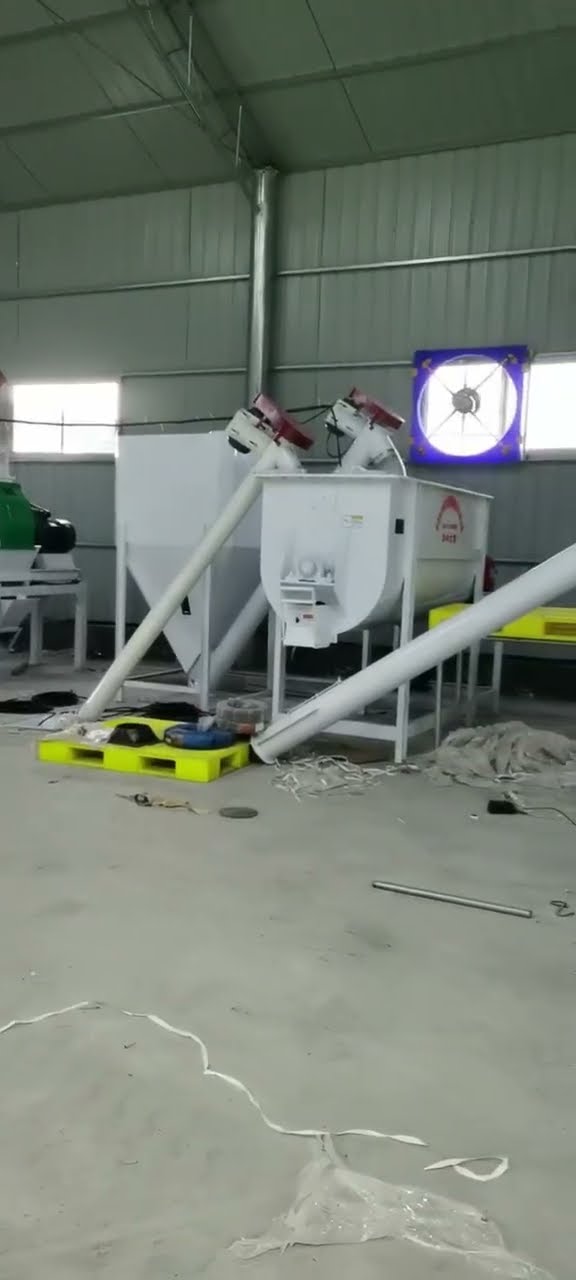
A New Mash Feed Production Line Was Launched
A mash feed production line leaving our workshop: hammer mill, ribbon mixer, conveying and bagging scale — the whole plant with no pellet mill on the frame.

Our Feed Pellet Production Lines Show
The flat die lines we build, filmed end to end, for comparison with the mash lines: same front half, plus conditioner, pellet mill and cooler.

Our Feed Pellet Machines Showroom
The machines that go into a mash line — hammer mills, mixers, screw conveyors, bagging scales — in one showroom walk-through.
Mash or pellet
Mash Feed Line or Pellet Line — the Honest Comparison
The two plants share their front half. The difference is what happens after the mixer, and what that does to your capital, your running cost and your product.
| Mash feed production line | Feed pellet production line | |
|---|---|---|
| Process | Grind, dose, mix, pack | Grind, dose, mix, condition, pellet, cool, pack |
| Steam boiler | Not needed | Needed from about 1 t/h upward |
| Pellet mill and die | None — no die bill, no roller wear | The main machine and the main wear part |
| Process motors at 2 t/h | ≈54 kW | ≈120 kW |
| Finished feed | Meal: lighter, dustier, can segregate in the bag | Pellets: denser, free-flowing, less waste at the trough |
| Best for | Local meal markets, wet feeding, on-farm mixing | Bagged retail feed, transport over distance, poultry and aquatic feed |
| Upgrade path | Add conditioner, pellet mill, cooler | Add a second mill, silo bank or bagging line |
The 2 t/h figures are the process motors of the two reference builds on this page against the 2000 kg/h ring die feed pellet line, which uses the same FS600 hammer mill and WJ-500 mixer.
Workshop and site
The Machines, and a Line in a Customer Shed
Everything on a mash line is a machine we already build for the pellet lines — which is why the two product families share a workshop and a spare-parts list.

A mash line fits in the building you already have
No boiler room, no cooler, no 15 m tower. A mash line runs on one level with a hammer mill, a mixer and a bagging scale, so a 6–8 m shed is usually enough and the layout can follow the building rather than the other way round.
That is also why the line is easy to extend: when the volume grows, the pellet mill and cooler go on the same floor, or the whole plant moves into a tower.

Hammer mills: the screen sets the fineness, the motor is sized for the finest grind.

Bagging: weigh, clamp, fill, stitch. A batch number on every bag.

A 2 t/h line in a customer shed — mill, mixer and bagging on one level.
FAQ
Mash Feed Production Line Questions
What is a mash feed production line?
When should I choose a mash line instead of a pellet line?
What capacity can you build?
Do I need steam for a mash feed production line?
Can I add a pellet mill later and turn it into a pellet line?
How fine should the feed be ground?
Can the line add oil, fat or molasses?
How accurate is the batching?
What about dust?
What do you need from us to quote a mash feed line?
Ask for a mash feed line proposal
Tell us the tonnage, the species, the formula and your building — we reply within 12 hours with a machine list and a drawing. Email info@pelletmachines.net or WhatsApp +86 186 0385 1787.
Send us the feed you want to sell and we will design the mash line around it
Tonnage, species, raw materials, building, power supply. That is enough for a machine list, a power schedule and a layout drawing. Pellet plants, mash plants and the custom builds are collected on our PROJECTS page.


