

Fish Feed Production Line
Floating and Sinking Aquatic Feed Plants
A fish feed production line is not a feed pellet line with a different die. Extrusion changes the process: finer grinding, cooking under pressure, expansion at the die, then drying and oil coating before cooling. We engineer the whole sequence — and we supply the formulas that make the pellets float.
Reference FOB price: USD 8,000 to USD 350,000 by capacity and floating or sinking configuration. Full equipment list and layout within 12 hours.

Floating, Slow-Sinking and Sinking Feed: What Changes
One extruder can make all three products. What changes is the screw configuration, the die, the formula and whether you add a vacuum coater. We specify all four when we design your line.
0.9–10 mm
Pellets expand at the die and stay on the surface over 2 hours. Lets farmers see exactly how much the fish eat.
1.5–8 mm
Neutral buoyancy for species that feed mid-water; set by expansion control.
1.5–8 mm
Shrimp and bottom feeders; higher density, minimal expansion.
2–10 mm
The same extruder makes dog and cat food — a second revenue stream from one asset.
Fish Feed Production Line Running Cost per Tonne
Four things cost money once a fish feed production line is running: power, labour, drying fuel and wear parts. Power is the easiest to predict. Installed load runs from about 25 kW on a small dry line to about 300 kW at 5 T/H, and the extruder takes the largest share.
Labour next. Two operators run a small line; four to six per shift at industrial scale. Wear parts come as a trickle, not a shock: die, screw and cutter blades, on a schedule you can plan for.
Drying is the variable that decides whether the line makes money. Pellets leave the extruder at 18–20% moisture and have to reach about 10–12% to store. On a tonne of feed that means boiling off roughly 90 kg of water, and water takes about 2,600 kJ per kilogram to evaporate.
So the heat demand is at least 235 MJ per tonne before any losses. A belt dryer runs at perhaps 50–65% thermal efficiency, which puts the real figure at 350–450 MJ per tonne. That is your gas, diesel or biomass bill — and the reason a dryer sized for 1 T/H will not dry 1.5 T/H however you set the burners.

Size the Dryer to Moisture, Not Tonnage
The commonest mistake in a fish feed line is matching the dryer to the extruder’s tonnage instead of to its water load. Tonnage alone tells you nothing. What the dryer removes is water, and that figure comes from moisture in against moisture out.
Take 1 T/H at 19% moisture going down to 11%. You are removing about 90 kg of water every hour, continuously. A belt dryer’s capacity is belt area times evaporation per square metre per hour. That figure is typically 8–15 kg, depending on air temperature, airflow and humidity.
Two things push the requirement up. Coastal and tropical humidity cuts evaporation in the rainy season, so a dryer that works in February fails in July. And almost every producer eventually runs the extruder above nameplate. 20–30% headroom absorbs that. A matched dryer becomes the bottleneck for the life of the plant.
Size the dryer up, not to the number on the extruder plate. Extra belt area costs far less than a second dryer two years later, and under-dried feed moulds in the bag — the one failure that loses a customer permanently.
Which extruder feeds the dryer also matters. A dry type fish feed extruder and a wet type fish feed extruder hand over mash at different moisture and different temperature, so the water load per tonne is not the same. Tell us which one you are running and we size the dryer against that, not against a catalogue figure.
Send us your target T/H and your moisture figures and we will put the dryer sizing, and its headroom, in writing with the quotation. Get a dryer sizing.

Fish Feed Production Line Specifications and Parameters
These are the process parameters we design to. They are also the acceptance criteria we test against before a line leaves the factory.
| Parameter | Value | Why it matters |
|---|---|---|
| Pellet diameter | 0.9–10 mm | Fry feed to large fish; set by die change. |
| Moisture before drying | 18–20% | Above this the pellet will not store; below it expansion suffers. |
| Pellet temperature before cooling | About 80 °C | Sets dryer load and cooler sizing. |
| Float behaviour | Floating / slow-sinking / sinking | Set by screw, die and formula — not by machine change. |
| Water stability | ≥ 2 h for floating feed | The number that decides feed conversion ratio and pond pollution. |
| Grinding fineness | Below 0.5 mm | Finer than poultry feed; drives pellet surface sealing. |
| Typical ingredients | Fish meal, fish oil, soy protein, wheat gluten, wheat and peas, minerals, vitamins, pigments | High protein and fat drive the process settings. |
| Downstream equipment | Dryer, oil coater, counterflow cooler, grading sieve, packing machine | Each must be sized to the extruder output. |
Free formulas are supplied with every line: floating fish, sinking shrimp and pet food, with the temperature, moisture and screw speed settings for each.
Line sizes we build
- 100–300 kg/h — pilot plant or single farm; dry type extruder, no boiler.
- 300 kg/h – 1 T/H — first commercial size; wet type extruder with boiler.
- 1–2 T/H — regional producer; dryer, vacuum coater and full cooling.
- 2–5 T/H — industrial aquatic feed plant; multi-line layouts available.
What you need at your site
- Power: from ~25 kW for a small dry line to ~300 kW at 5 T/H.
- Steam: required for wet type; roughly 0.3–1.5 t/h boiler by capacity.
- Floor area: from ~40 m² for a small line to ~400 m² at 5 T/H.
- Operators: 2 at small scale, 4–6 per shift at industrial scale.
Quick quote — fish feed line
Tell us the species, target T/H and whether you want floating or sinking feed. We reply with the equipment list, layout and landed price. Send the details to info@pelletmachines.net or WhatsApp +86 186 0385 1787 — engineers reply within 12 hours.
Fish Feed Production Line Process: 8 Stages
A fish feed production line runs eight stages as one material flow, not a list of machines: grinding, batching, conditioning, extruding, drying, oil coating, cooling, then screening and packing. Each stage sets the input for the next, so the line only runs as fast as its slowest machine.
Grinding fineness decides how the die behaves, the output of the fish feed pellet machine sets the dryer area, and dryer output sets the coater and cooler. That is why we size the line backwards, from the dryer.
The two that newcomers underestimate are drying and oil coating — both directly determine whether the feed sells.
- 1 · Fine grindingUltra-fine hammer mill to below 0.5 mm
- 2 · Batching & mixingFormula weighed and blended, CV ≤ 5%
- 3 · ConditioningSteam pre-cooks mash to 80–90 °C (wet type)
- 4 · ExtrudingScrew builds 40 bar and 120–150 °C; starch gelatinises
- 5 · DryingBelt dryer brings 18–20% moisture down to storage level
- 6 · Oil coatingVacuum coater adds fish oil up to 20%+ without soaking
- 7 · CoolingCounterflow cooler to ambient +3–5 °C
- 8 · Screening & packingGrading sieve removes fines, then weigh and bag
Fish Feed Lines and Extruders in Production
Real clips from our factory and from customer plants — dry and wet extruders, complete lines, pet food production.
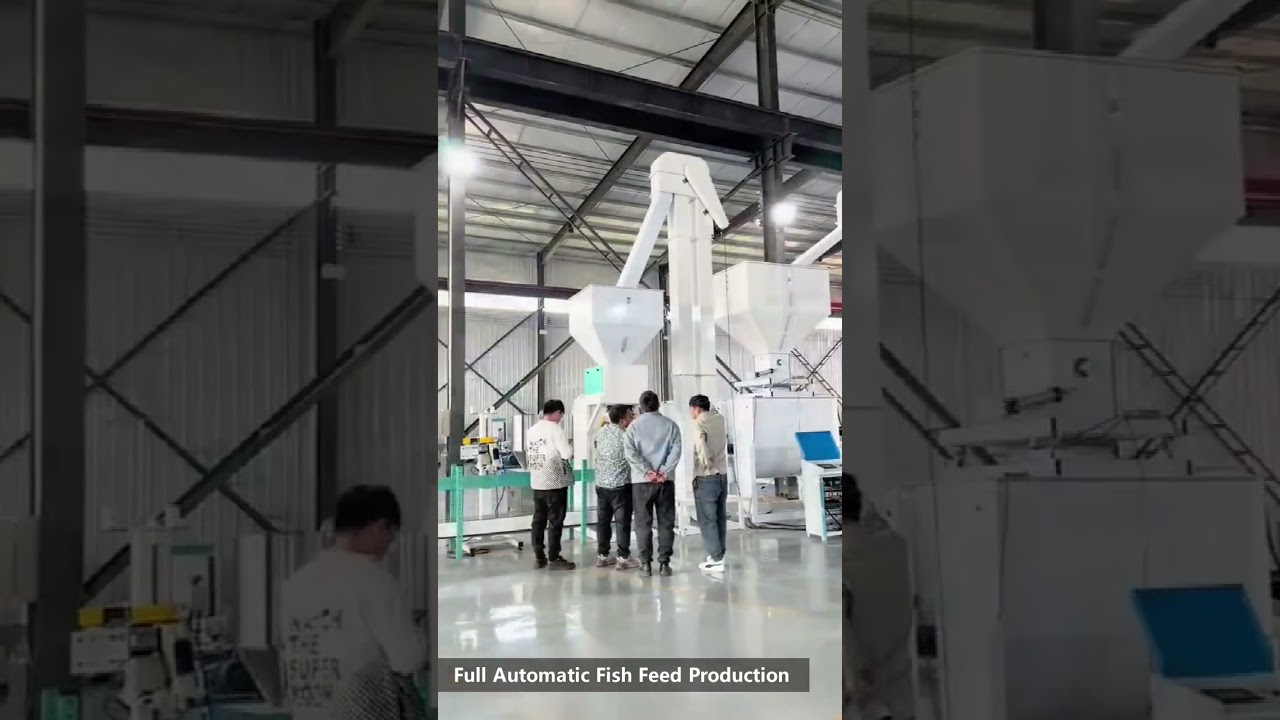
Complete wet type fish feed production line
A full wet type line running — extruder, dryer, cooler and packing in sequence.

Fish feed machinery factory showroom
The full fish feed machine range in one factory walkthrough.

Dry type fish feed extruder working demonstration
Dry type extrusion without a boiler — the entry point for small plants.
Extruder line or ring die line — which do you need?
Choose an extruder line if your market wants floating feed, if you need the 0.9 mm fine end of the size range, or if you plan to sell pet food alongside fish feed. Extrusion is the only way to make feed float.
Choose a ring die line if you produce sinking shrimp or fish feed at higher tonnage. A ring die mill is cheaper per ton of capacity, uses less energy and produces a denser pellet. See the ring die aquatic feed pellet mill.
Many serious producers run both: an extruder line for floating feed and pet food, a ring die line for volume sinking feed. We engineer both and can supply them as one project.

- Floating feed with over 2 hours float time
- Pellet size 0.9–10 mm from fry feed to large pellets
- Dry type (no boiler) or wet type (higher capacity) configurations
- Free floating, sinking and pet food formulas with every line
- Dryer and vacuum coater sized to extruder output
- Every stage balanced — no hidden bottleneck in the sequence
Machines in a Fish Feed Production Line
Each machine has its own specification page. We select and size them as one balanced project.
- Ultra Fine Hammer Mill
- Double Paddle Feed Mixer
- Fish Feed Pellet Machine (Extruder)
- Dry Type Fish Feed Extruder
- Wet Type Fish Feed Extruder
- Feed Pellet Coating Machine
- Counterflow Pellet Cooler
- Rotary Grading Sieve
- Vibrating Grading Sieve
- Weighing & Packing System
- Automatic Batching System
- PLC Control System
Fish Feed Pellet Production Line Questions
How much does a fish feed production line cost?
Can one line make both floating and sinking feed?
Do I need a steam boiler?
Do you supply feed formulas?
How long do the pellets float?
What is the difference from a normal feed pellet line?
How long does delivery and installation take?
What support comes after installation?
Ask for a fish feed line proposal
Send the species, target T/H, floating or sinking, and your power and steam situation. You get the equipment list, layout drawing and investment range within 12 hours. Send the details to info@pelletmachines.net or WhatsApp +86 186 0385 1787 — engineers reply within 12 hours.
Aquatic Feed Equipment and Installed Projects
- Dry Type Fish Feed Extruder
- Wet Type Fish Feed Extruder
- Fish Feed Pellet Machine
- Ring Die Aquatic Feed Pellet Mill
- Feed Pellet Production Line
- Ultra Fine Hammer Mill
- Feed Pellet Coating Machine
- Counterflow Pellet Cooler
- 5 Sets Extruder to Ghana
- DGP70 Wet Line to Nigeria
- Fish Feed Stabilizer to Philippines
- Plant Installed in Bangladesh
Get Your Fish Feed Line Designed
Send the species, target tonnage and whether you want floating or sinking feed. You get the equipment list, layout drawing, formulas and an investment range within 12 hours.


