
6000 kg/h Ring Die Feed Pellet Production Line One Big Mill, One Tower, Six Tons an Hour
A complete 6000 kg/h feed pellet line built as a tower around the HM-400 ring die feed pellet mill: an SD800 hammer mill at 90 kW, a WJ-2000 mixer, a Ø400 mm die at 95 kW, and two NL-14 coolers sized for the output — 229 kW of motors on a 260 kW cabinet, on a 15 × 15 m footprint with 15 m of height. At this size the plant is engineered to your building and your formula, and every machine in it can be added, removed or upsized before we quote.
A plant this size is quoted as a project: silo capacity, conditioning, conveying and bagging change the scope more than the mill does. Send us your formula, target tonnage and building, and we return the equipment list, a layout and a landed budget within 12 hours.

What the 6000 kg/h Feed Pellet Line Contains
Six items and 229 kW. Everything on this 6 t/h Feed Pellet Line is one size up from the 5 t/h Feed Pellet Plant: a 900 mm-wide grinding chamber instead of 600, a 2,000 kg batch mixer instead of 500, a Ø400 die instead of Ø350, and a cooler with three times the air. Each stage below can be changed, and machines you do not need are left out of the quote rather than sold as part of a package.
SD800 feed hammer mill
90 kW, a 900 mm grinding chamber and a 2,330 mm body — the mill that keeps a Ø400 die fed. At 6 t/h the grinder is the machine most often under-specified, and a grinder that cannot out-run the pellet mill sets the output of the whole plant.
WJ-2000 horizontal ribbon mixer
22 kW, 2,000 kg batch on a 3,800 mm body. A batch this size is what lets the mill run continuously between discharges instead of waiting on a 500 kg mix.
LX220 screw conveyor
4 kW, 4,500 mm reach, 220 mm tube — the same loader we use at 2 t/h, because on this plant the conveying duty is done by bucket elevators and the screw only trims the mill hopper.
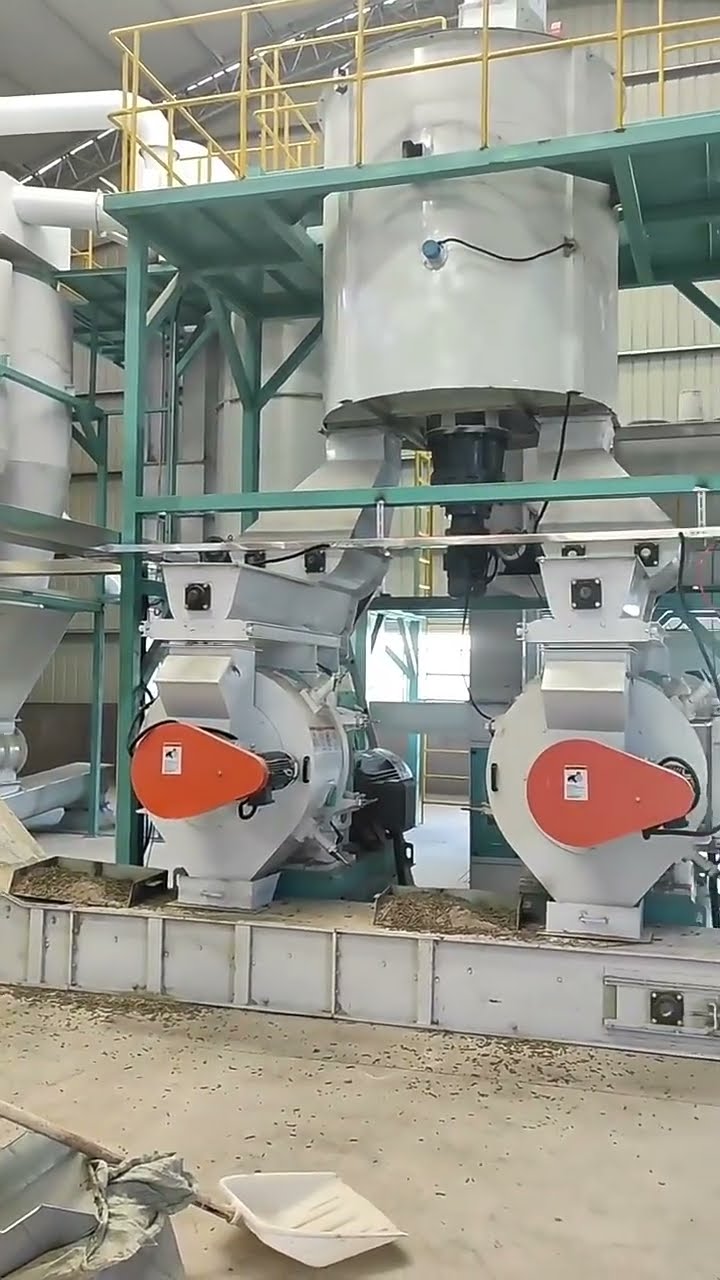
HM-400 ring die feed pellet mill
95 kW on a Ø400 mm die, 1,760 × 1,710 × 1,650 mm. One big mill instead of two smaller ones: fewer drives, one conditioner, one die to manage — and 5,000–7,000 kg/h on a 4–6 mm pellet.
2 × NL-14 pellet coolers, 18.1 kW
2,480 × 1,700 × 3,400 mm each, 18.1 kW for the pair — this is not a cooler you can substitute with a fan and a concrete floor. Six tons an hour of 80 °C pellets needs a counterflow bed with real air volume behind it, and the cooler is the machine that decides whether your bagged feed is still sound in three months.
One control cabinet (260 kW) runs the whole 6000 kg/h feed pellet line. The 260 kW rating against 229 kW of process motors is deliberate: it leaves room for the conditioner, the feeders and the elevator drives that a plant this size needs, and it means the cabinet is not rebuilt the first time you add a stage. Ammeters on the mill main motor and the feeder are what the operator actually runs the plant on.

6000 kg/h Ring Die Feed Pellet Line — Machine Configuration
This is the configuration from our factory sheet. Motor voltage, die thickness and pellet diameter are set to your material before shipment, and the machine list is adjusted to your process: the hammer mill comes out if you buy pre-ground mash, a steam conditioner and silo bank go in for a commercial mill, and the cooler bank takes a third unit if you run two shifts.
| Stage | Equipment | Model | Power | Dimensions L×W×H (mm) | Qty |
|---|---|---|---|---|---|
| 1. Grinding | Feed hammer mill | SD800 | 90 kW | 2330 × 1050 × 1150 | 1 |
| 2. Mixing | Horizontal ribbon feed mixer | WJ-2000 | 22 kW | 3800 × 1450 × 2350 | 1 |
| 3. Conveying | Screw conveyor / loader | LX220 | 4 kW | 4500 × 800 × 1850 | 1 |
| 4. Pelleting | Ring die feed pellet mill | HM-400 | 95 kW | 1760 × 1710 × 1650 | 1 |
| 5. Cooling | Counterflow cooler | NL-14 × 2 | 9.05 kW each | 2480 × 1700 × 3400 each | 2 |
| 6. Control | Control cabinet for the line | — | 260 kW total | — | 1 |
Installed power 229 kW — 90 + 22 + 4 + 95 + 18.1 — on a 260 kW cabinet rating, which leaves room for the conditioner, feeders and elevator drives. Footprint 15 × 15 m with 15 m of height on the sheet: this is a tower, so the height is the elevator head and the mill floor, not the mill itself. Output is quoted for dry grain mash at 12–15% moisture on a 4–6 mm die; a 2–3 mm die or a high-fibre formula reduces it, and conditioning adds 15–25%.
What the 6000 kg/h feed pellet line needs at your site
- Floor: 15 × 15 m of level concrete, and 15 m of clear height for the tower and the elevator head. A building with a crane beam over the mill floor pays for itself at maintenance time.
- Power: three-phase supply sized from the electrical schedule we send with the quotation; 229 kW of motors before the conditioner and the elevators.
- Steam: a steam generator or your existing boiler — at 6 t/h a conditioner is standard, not optional.
- Raw material: bulk delivery into a silo bank or an intake pit. Bags cannot feed six tons an hour.
- Operators: two to three per shift, plus a mill operator who owns the die.
Every machine in the line is optional
We configure the 6000 kg/h feed pellet line around your process. Buy pre-ground mash and the SD800 comes out. Run one shift and one cooler is enough; run two and we double it. Sell one formula and the batching system never goes in. Want a second HM-400 on the same floor later? We size the steel and the elevators for it now so the second mill is a week’s work instead of a rebuild. Nothing in the table above is compulsory.
Quick quote — 6000 kg/h ring die feed pellet line
Tell us the formula, the target tonnage, the building you have and whether steam is available. We reply with the equipment list, a layout section and a landed budget for that scope. Send the details to info@pelletmachines.net or WhatsApp +86 186 0385 1787 — engineers reply within 12 hours.
How the 6000 kg/h Feed Pellet Line Runs, Stage by Stage
Five working stages laid out as a tower: material is lifted once to the top floor and then falls through the plant by gravity, stage by stage. That is why the sheet quotes 15 m of height for a 15 × 15 m footprint — vertical is cheaper than horizontal at this output.
- 1 · GrindingSD800 hammer mill, 90 kW — a 900 mm chamber grinding faster than the die can consume it, so the mill floor always has a buffer
- 2 · MixingWJ-2000 ribbon mixer, 22 kW — 2,000 kg batches, so the mill runs continuously between discharges instead of waiting on a mix
- 3 · ConveyingBucket elevators to the mill floor, LX220 screw trimming the hopper — one lift, then gravity all the way down
- 4 · Conditioning & pelletingHM-400 ring die mill, 95 kW, Ø400 die — conditioner above, 2–8 mm pellets by die change
- 5 · Cooling & bagging2 × NL-14 coolers, 18.1 kW — 2,480 × 1,700 × 3,400 mm each of counterflow bed, then belt and bag

The 6000 kg/h Feed Pellet Line on Video
Four clips. The showroom walk-through covers the machines on this line; the ring die working-principle video shows what happens inside the HM-400; the 4 t/h ruminant plant is the same architecture one size down; the flat die show is there if you are still comparing the two technologies.

Our Feed Pellet Machines Showroom Complete Animal Feed Pellet Plant Solutions
A walk through the showroom: ring die mills, conditioners, coolers and the complete plant solutions built around them.

Ring Die Animal Aquatic Feed Pellet Machine Structure and Working Principle Video
Inside a ring die mill: the die, the rollers pressing outward, the cutter setting pellet length and the conditioner feeding the chamber.
4TPH Ruminant Animal Feed Pellet Plant. Complete Feed Pellet Production Solution
A 4 t/h ruminant feed plant on site — the same tower architecture as this 6000 kg/h feed pellet line, one size down.

Various Capacity Flat Die Feed Pellet Production Lines Video Show
The flat die lines we build at the smaller end — worth watching if you are weighing a flat die against a ring die before committing to a tower.
Machines We Can Add to Your 6000 kg/h Feed Pellet Line
We do not sell one fixed package, and at this size nobody would buy one. The 6000 kg/h feed pellet line is engineered to your formula, your building and your delivery pattern; everything below is quoted as part of the same plant, with the original order or as a later upgrade.
Raw material silo bank
Maize and soybean meal silos with screw discharge, sized to your delivery pattern — at 6 t/h the intake side decides whether the mill ever runs at full rate.
Steam generator & conditioner
Standard on a plant this size: 80–90 °C mash, 15–25% more output and far longer die life. Without it the Ø400 die wears fast enough to notice on the monthly bill.
Automatic batching system
Weighs each ingredient by recipe. At six tons an hour, hand dosing is not a formula control system, it is a hope.
Molasses / liquid adding machine
Adds molasses, oil or fat evenly after mixing — the difference between one product and a range.
Rotary feed pellet grading sieve
Separates whole pellets from crumbs and dust before the bag; fines return to the mill.
Weighing & packing system
5–25 kg bags at ±0.2% accuracy with conveyor and sewing head — at this output one bagging line is usually the bottleneck, so plan for two.
PLC control system
Sequenced start/stop, interlocks and production reporting for the whole tower, including the elevator and bagging interlocks.
Second HM-400 mill
The plant is sized so a second mill can go on the same mill floor later — double the pelleting capacity without touching the building.
Beyond these: a second bagging line, bulk bag filling, a pellet crumbler, a magnet and safety screen before the mill, dust collection on the silo intakes and the bagging point, a finished-product silo bank instead of bags, and a weighbridge interface at intake. At this scale the plant is a design exercise — describe the process and we quote the systems for it.
What a 15 × 15 m Tower Buys You
A 15 × 15 m footprint with 15 m of height is the shape of every plant at this output — vertical, because conveying six tons an hour horizontally costs more in steel and power than lifting it once.
If your building is long rather than tall, the same machines can be laid out as a two-level line like the 5000 kg/h ring die feed pellet line — you lose some of the gravity flow and gain a building you already own. Send us the dimensions and we will tell you which layout your building supports before you spend anything on steel.
The 6000 kg/h Feed Pellet Line on Site
A plant at this size is erected on site, so these photographs come from erection and commissioning rather than from our workshop floor.
What we check before the tower goes up
The building comes first. We take your dimensions, your intake side and your finished-goods side, and draw the section before any steel is cut: that fixes the mill floor height, the elevator centres and where the bagging line lands. Change one of them afterwards and you pay for the steel twice.
Then the die and the drive. A Ø400 die at 95 kW is a lot of stored energy, so the coupling, the shear pin and the feeder interlock are set and tested on load before we hand the plant over — and the operator is trained on the feeder ammeter, which is the instrument that tells you the die is loading up before the main motor does.
Running Cost and Payback for a 6000 kg/h Feed Pellet Line
At 6 t/h and eight hours a day the plant turns out forty-eight tons of feed; on two shifts it is a hundred. At this scale the investment case is not a farm saving money on its own feed — it is a feed business, and the number that decides the project is the margin per ton and the tonnage you can actually sell.
| Scenario | Output per day | Typical saving vs bought feed | Indicative payback |
|---|---|---|---|
| Commercial feed mill, one shift | 48 t/day | USD 40–70 per ton | 14–26 months |
| Commercial mill, two shifts | 96 t/day | USD 40–70 per ton | 9–18 months |
| Large integrator, own consumption | 48 t/day | USD 25–50 per ton | 20–34 months |
Assumes 8 running hours at 5,000–7,000 kg/h and a raw material cost typical for maize and soybean meal formulas. Power and steam are the running costs worth metering per ton rather than estimating — the electrical schedule we send with the quotation is what to build the model on. And the honest caveat for a plant this size: the machine price is rarely what kills the project, under-used capacity is. If your realistic volume is 3 t/h, buy the 5000 kg/h plant and run it full.
6000 kg/h Feed Pellet Line Questions
What machines are included in the 6000 kg/h feed pellet line?
Can the 6000 kg/h feed pellet line be customised?
Why one HM-400 instead of two smaller mills?
How is this different from the 5000 kg/h ring die feed pellet line?
Is 6000 kg/h realistic for one HM-400?
Do I need steam at this size?
What building does it need?
What power supply does it need?
How long does it take to build and commission?
Can the same plant make aquatic or ruminant feed?
Ask for a proposal for your 6000 kg/h feed pellet line
Send your formula, your realistic monthly tonnage, your building dimensions and whether steam is available. You get the equipment list, a layout section and a landed budget for that scope within 12 hours. Send the details to info@pelletmachines.net or WhatsApp +86 186 0385 1787.
Your 6000 kg/h Feed Pellet Line, Engineered to Your Building
Tell us the formula, the tonnage and the building. We come back with an equipment list, a layout section and an investment range for exactly that plant — and if 3 t/h is the honest answer for your market, we will say so.


