
5000 kg/h Ring Die Feed Pellet Production Line A Tower Plant, Not a Line of Machines
A complete 5000 kg/h feed pellet line built as a tower: raw material silos, grinding, mixing with automatic fat addition, steam conditioning, HM-350 ring die pellet mills, cooling and bagging, with the control system, compressed air and steam generator that hold it together. At five tons an hour the mill stops being the bottleneck and the raw-material side takes over — which is why this page is organised by system, and why every system in it is sized and added to your formula rather than sold as a package.
A plant this size is quoted as a project: silo capacity, steam, fat addition and bagging change the scope more than the mill does. Send us your formula, your target tonnage and your building, and we return the system list, a layout and a landed budget within 12 hours.

What the 5000 kg/h Feed Pellet Line Contains
Five working stages and four support systems. On a 5 t/h plant the machines that matter most are the ones a small line does not have at all — the silos that let a truck tip in ten minutes, the steam that makes the die last, and the fat addition that lets you sell more than one formula. Each of them is in or out of the quote on your instruction.
Raw material silos
35 t maize and 15 t soybean meal, with screw discharge under each and a separate micro-ingredient hopper. Silos are what turn a 5 t/h plant from a machine that waits for bags into one that runs a shift on its own.
Feed hammer mill with cyclone
Sized to the mill, not to the silo: the grinder has to out-run the pellet mill by enough to keep a buffer in front of it, or the die starves every time the screen blinds.
Horizontal ribbon mixer
Batch mixing with automatic oil and fat addition on the discharge side — the system that makes high-energy formulas possible without hand dosing.
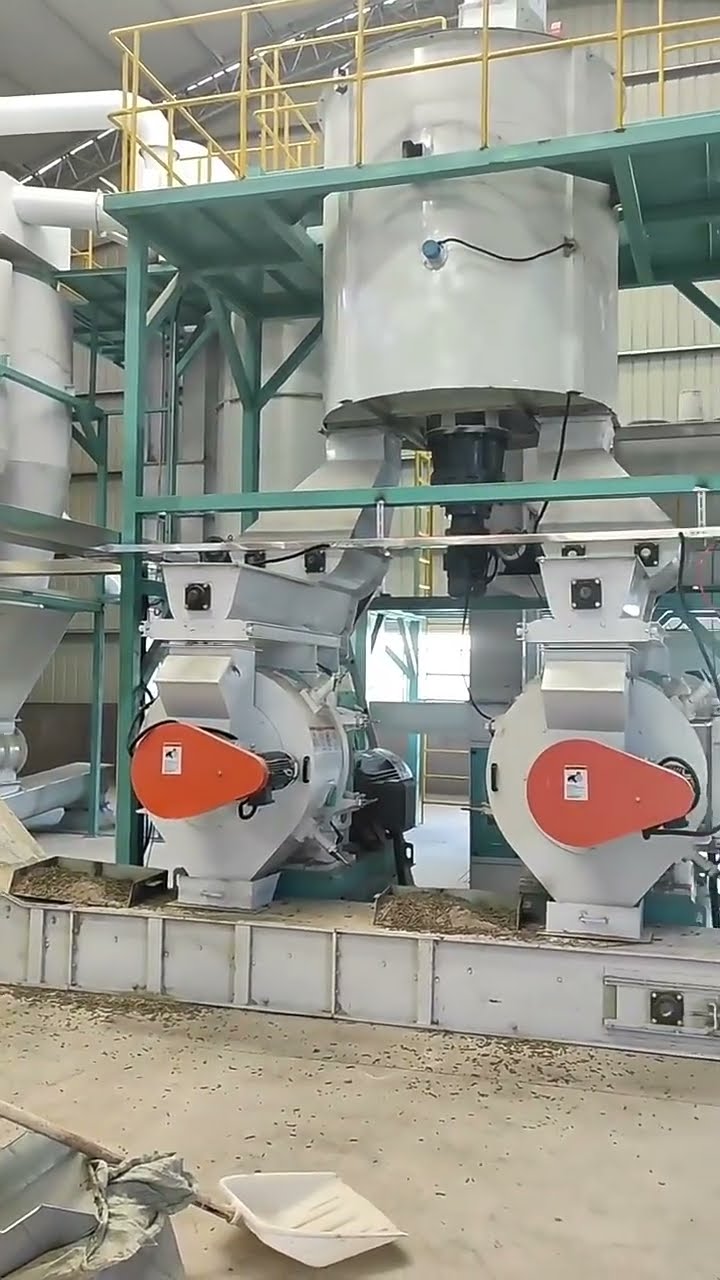
HM-350 ring die pellet mills
Ø350 mm ring die with a steam conditioner above each mill. Two mills on one platform is how this plant holds 3–5 t/h and still keeps producing while one die is changed.
Counterflow cooler, belt conveyor and bagging scale
A ring die at this output delivers a hot, dense pellet, and at five tons an hour you cannot spread it on the floor to cool. The counterflow cooler brings the bed down to within a few degrees of ambient, the belt takes it to the bagging scale, and the bag is sewn and stacked — the point where a plant starts to look like a factory instead of a workshop.
One control system runs the whole 5000 kg/h feed pellet line: sequenced start and stop across the elevators, the mill, the cooler and the bagging line, interlocks so nothing downstream is buried, and ammeters on each mill. At this size the sequence matters more than any single machine — starting five tons an hour of conveying in the wrong order is how you spend a day digging out a boot.

5000 kg/h Feed Pellet Line — What the Plant Is Made Of
We do not publish a single fixed machine list for this size, because a 5 t/h plant is quoted as a project and the scope moves with the formula. What follows is the system breakdown from the design file behind the plant in these photographs — silo capacity, conditioning, fat addition and bagging are the four items that change most between customers, and all four are yours to set.
| Stage | System | Key equipment | Qty |
|---|---|---|---|
| 1. Intake & storage | Raw material silos | Maize silo 35 t, soybean meal silo 15 t, micro-ingredient hopper | 3 |
| 2. Grinding | Grinding section | Feed hammer mill with cyclone and bag filter | 1 |
| 3. Mixing | Mixing section | Horizontal ribbon mixer with automatic oil / fat addition | 1 |
| 4. Conditioning | Steam conditioning | Steam conditioner per mill, fed by a steam generator | 2 |
| 5. Pelleting | Pelleting section | HM-350 ring die feed pellet mill, Ø350 mm die | 2 |
| 6. Cooling | Cooling section | NL-14 counterflow cooler with fan | 1 |
| 7. Conveying | Conveying set | Bucket elevators to the platform, screw conveyors between stages | set |
| 8. Packing | Packing section | Weighing and bagging machine with belt conveyor | 1 |
| 9. Auxiliary | Support systems | Control system, compressed air system, automatic fat adding system | set |
We have deliberately left installed power off this table: the electrical schedule follows the die diameter, whether both mills run at once, and whether you condition — and a number invented here would be wrong for your plant. Send your target tonnage, pellet diameter and formula and we return the full electrical schedule with the quotation. Output is quoted for dry grain mash at 12–15% moisture on a 4–6 mm die; a 2–3 mm die or a high-fibre formula reduces it.
What the 5000 kg/h feed pellet line needs at your site
- Floor: a two-level steel platform, with the mills and conditioners above and the cooler, bagging line and control room at floor level. Height matters more than area — plan for 8–10 m to the top of the elevators.
- Power: a three-phase supply sized from the electrical schedule we send with the quotation, not from a catalogue figure.
- Steam: a steam generator, or a connection to an existing boiler. Water treatment matters here — scale in a conditioner is a maintenance bill every month.
- Raw material: bulk delivery, tipped into a pit or an intake hopper; bagged material defeats the point of the silos.
- Operators: two per shift, one on the mill and one on bagging, plus a supervisor.
Every system in the plant is optional
This is a project, not a package. No silos and you tip bags into an intake hopper instead — cheaper, and three more people on the payroll. No steam and the die runs colder and wears faster. No fat addition and you sell one formula instead of three. No second mill and the plant tops out around 2.5 t/h with a spare platform waiting. Tell us which of those trades you want to make and we build the plant around it — including starting at 2.5 t/h with the structure already sized for five.
Quick quote — 5000 kg/h ring die feed pellet line
Tell us the formula, the target tonnage, the raw material you can actually buy and whether you have steam and three-phase power. We reply with the system list, a layout for your building and a landed budget for that scope. Send the details to info@pelletmachines.net or WhatsApp +86 186 0385 1787 — engineers reply within 12 hours.
How the 5000 kg/h Feed Pellet Line Runs, Stage by Stage
Five working stages, four support systems and a control system that sequences them. The sequence is the design: material flows up once, comes down through the mill by gravity, and never has to be lifted twice.
- 1 · IntakeMaize and soybean meal tipped into the silos, micro-ingredients into their own hopper — 35 t and 15 t of buffer before anything starts
- 2 · GrindingHammer mill with cyclone and bag filter, sized to out-run the mills so the die never starves
- 3 · MixingRibbon mixer with automatic oil and fat addition — the system that lets you sell more than one formula
- 4 · Conditioning & pelletingSteam conditioner over each HM-350 ring die mill, Ø350 die, 2–8 mm pellets
- 5 · Cooling & baggingCounterflow cooler, belt conveyor, weighing and bagging machine, sewn and stacked

The 5000 kg/h Feed Pellet Line on Video
Four clips. The showroom walk-through and the ring die working-principle video explain the machines; the 4 t/h ruminant plant is the closest thing we have on film to this 5 t/h layout; the flat die show is there for comparison if you are still weighing the two technologies.

Our Feed Pellet Machines Showroom Complete Animal Feed Pellet Plant Solutions
A walk through the showroom: ring die mills, conditioners, coolers and the complete plant solutions built around them.

Ring Die Animal Aquatic Feed Pellet Machine Structure and Working Principle Video
Inside a ring die mill: the die, the rollers pressing outward, the cutter setting pellet length and the conditioner feeding the chamber.
4TPH Ruminant Animal Feed Pellet Plant. Complete Feed Pellet Production Solution
A 4 t/h ruminant feed plant on site — silos, grinding, mixing, conditioning, pelleting and bagging, the same architecture as this 5000 kg/h feed pellet line.

Various Capacity Flat Die Feed Pellet Production Lines Video Show
The flat die lines we build at the smaller end, for customers weighing a flat die against a ring die at this output.
Systems We Can Add to Your 5000 kg/h Feed Pellet Line
A plant at this size is assembled from systems, and every one of them can be added, removed or upsized. Tell us the formula, the tonnage and the building, and we build the plant around those three answers — starting at 2.5 t/h with the structure already sized for five is a perfectly normal way to buy this.
Larger raw material silos
35 t and 15 t are the sizes in this build. Bigger silos mean fewer deliveries and a better price on grain — usually the cheapest upgrade per ton on the whole plant.
Automatic batching system
Weighs each ingredient by recipe instead of by hand. Above two formulas, this stops being an option and becomes the only way to keep the label honest.
Steam generator & conditioner
The single biggest gain in output and die life on a ring die plant — and at 5 t/h the steam bill is small next to the die bill.
Molasses / liquid adding machine
Adds molasses, oil or fat evenly after mixing. On ruminant feed this is what lets you hit an energy spec without hand dosing.
Rotary feed pellet grading sieve
Separates whole pellets from crumbs and dust before the bag; fines go back through the mill instead of to the customer.
Weighing & packing system
5–25 kg bags at ±0.2% accuracy, with belt conveyor and sewing head — at this output the bagging line is a bottleneck in its own right.
PLC control system
Sequenced start/stop, interlocks and production reporting for the whole plant, including both mills and the bagging line.
6000 kg/h ring die feed pellet line
The next size up uses the same architecture with an SD800 mill and a 15 × 15 m tower — see the 6000 kg/h ring die feed pellet line.
Beyond these: a second bagging line, bulk bag filling, a pellet crumbler, a magnet and safety screen before each mill, dust collection on the silo intakes and the bagging point, a weighbridge interface for intake, and a finished-product silo bank instead of bags. At this scale the plant is a design exercise, so describe the process and we quote the systems for it.
How the 5000 kg/h Feed Pellet Line Is Laid Out
This is the layout drawing from our design file for the 3–5 t/h version of this plant — drawn as a section through the building, with the silos at the intake end and the bagging line at the far end. It is the clearest single picture of why a plant at this size needs height rather than floor area.

The plant in our photographs is this layout built on a two-level steel platform rather than in a concrete tower: mills and conditioners above, cooler and bagging at floor level, elevators on the outside. It is cheaper to erect and it can be extended, which is why most of the 5 t/h plants we ship look like this rather than like a grain silo complex. Send us your building and we return the same drawing marked to your dimensions.
The 5000 kg/h Feed Pellet Line on Site
A 5 t/h plant is assembled on site rather than shipped whole, so these photographs are from erection and commissioning — the stage where the layout either works or does not.
What we check before the plant goes up
At this size the plant is engineered to the building: we take your dimensions, your intake side and your finished-goods side, and draw the section before anything is fabricated. That drawing fixes the platform height, the elevator centres and where the bagging line lands — change any of them after the steel is cut and you pay for it twice.
Then the sequencing. The control system is written so that nothing starts until the machine downstream of it is running, and nothing stops until the material in it has cleared. On a 5 t/h plant that logic is worth more than any single machine: one boot full of pellets is a day of production and a week of cleaning out.


Running Cost and Payback for a 5000 kg/h Feed Pellet Line
At 5 t/h and eight hours a day the plant turns out forty tons of feed — a commercial feed mill, not a farm line. Payback comes from the gap between bought feed and home-mixed feed plus whatever margin you take on selling it, so the table below is the arithmetic to put your own prices into.
| Scenario | Output per day | Typical saving vs bought feed | Indicative payback |
|---|---|---|---|
| Commercial feed mill, one shift | 40 t/day | USD 40–70 per ton | 12–24 months |
| Commercial mill, two shifts | 80 t/day | USD 40–70 per ton | 8–16 months |
| Large integrator, own consumption | 40 t/day | USD 25–50 per ton | 18–30 months |
Assumes 8 running hours at 3,000–5,000 kg/h and a raw material cost typical for maize and soybean meal formulas. Power and steam are the other running costs, and at this size they are worth metering per ton rather than estimating: the electrical schedule we send with the quotation is what to build the model on. Payback on a plant this size is driven less by the machine price than by how many tons you actually sell, so we would rather quote you a 2.5 t/h plant that runs full than a 5 t/h plant that runs at half load — send us your realistic monthly tonnage and we will say which one to buy.
5000 kg/h Feed Pellet Line Questions
What is in the 5000 kg/h feed pellet line?
Can the 5000 kg/h feed pellet line be customised?
Do I need two mills?
Why are the silos such a big part of the price?
How is this different from the 2000 kg/h ring die feed pellet line?
Is 5000 kg/h realistic, and what does it depend on?
What building does it need?
What about power, steam and compressed air?
How long does it take to build and commission?
Can the same plant make aquatic or ruminant feed?
Ask for a proposal for your 5000 kg/h feed pellet line
Send your formula, your realistic monthly tonnage, your building dimensions and whether you have steam and three-phase power. You get the system list, a layout section and a landed budget for that scope within 12 hours. Send the details to info@pelletmachines.net or WhatsApp +86 186 0385 1787.
Your 5000 kg/h Feed Pellet Line, Engineered to Your Building
Tell us the formula, the tonnage and the building. We come back with a system list, a layout section and an investment range for exactly that plant — and if 2.5 t/h is the honest answer for your market, we will say so.


