
2000 kg/h Ring Die Feed Pellet Production Line One Mill, Harder Pellets, Steam If You Want It
A complete 2000 kg/h feed pellet line built around the HM-320 ring die feed pellet mill: grind, mix, convey, condition, pellet and cool in a single run, on a 25 × 6 m floor allowance and 107 kW. A ring die compresses harder than a flat die, so this is the 2 t/h line for high-fibre, high-molasses and high-fat formulas — and because the machine list is written for your process, any stage in it can be added, removed or upsized before we quote.
Price depends on how much of the plant you take — the machine list is written for your process, not copied from a catalogue. Tell us the stages you need and we return the equipment list, a dimensioned layout drawing and a landed quote within 12 hours.

What the 2000 kg/h Ring Die Feed Pellet Line Contains
Six items and 107 kW. A ring die mill does more work per kilowatt than a flat die on the same mash, which is why one HM-320 covers the two tons an hour that took two flat die mills on the other 2000 kg/h feed pellet line. Every stage below can be changed, and machines you do not need are left out of the quote rather than sold as part of a package.
FS600 feed hammer mill
37 kW on a 600 mm rotor — a wider grinding chamber than the 500 mm mill, because a ring die wants a finer, more even mash than a flat die does. Cyclone and ducting discharge into the mixer.
WJ-500 horizontal ribbon mixer
11 kW, 500 kg batch on a heavy reducer. The heavier motor is for mash that already carries molasses or oil: it keeps the ribbon turning in a sticky batch instead of stalling.
LX220 screw conveyor
4 kW, 4,500 mm reach and a 220 mm tube — the larger diameter is what moves damp, molasses-bearing mash without bridging in the flight.
HM-320 ring die feed pellet mill
48 kW, Ø320 mm die, two rollers on a fixed die, 1,500–2,500 kg/h. Ring die pressure is higher and more even than a flat die, so pellets come out harder with fewer fines — and the die and roller set can be changed for 2–8 mm pellets.
NL-11 pellet cooler, 7 kW
A ring die delivers a denser, hotter pellet than a flat die — 70–90 °C off the die — so cooling is not optional here. The NL-11 pulls air through the bed until the pellets are within a few degrees of ambient, which also sets their final hardness: cool them too fast and they craze, too slow and they sweat in the bag.
One control cabinet (120 kW) runs the whole 2000 kg/h feed pellet line: a separate starter per motor, overload protection, and ammeters on the mill main motor and the die feeder. On a ring die the feeder ammeter is the one to watch — it tells the operator how hard the die is working long before the main motor complains.

2000 kg/h Ring Die Feed Pellet Line — Machine Configuration
This is the configuration from our factory sheet. Motor voltage, die thickness and pellet diameter are set to your material before shipment, and the machine list itself is adjusted to your process: the hammer mill comes out if you buy pre-ground mash, a conditioner and steam generator go in if you pellet high-molasses formulas, and a grading sieve or bagging line can be added.
| Stage | Equipment | Model | Power | Dimensions L×W×H (mm) | Qty |
|---|---|---|---|---|---|
| 1. Grinding | Feed hammer mill | FS600 | 37 kW | 1340 × 950 × 1350 | 1 |
| 2. Mixing | Horizontal ribbon feed mixer | WJ-500 | 11 kW | 2700 × 1050 × 2350 | 1 |
| 3. Conveying | Screw conveyor / loader | LX220 | 4 kW | 4500 × 800 × 1850 | 1 |
| 4. Pelleting | Ring die feed pellet mill | HM-320 | 48 kW | 1560 × 1310 × 1250 | 1 |
| 5. Cooling | Pellet cooler | NL-11 | 7 kW | — | 1 |
| 6. Control | Control cabinet for the line | — | 120 kW total | — | 1 |
Installed power 107 kW — 37 + 11 + 4 + 48 + 7 — on a 120 kW cabinet rating, which leaves headroom for the conditioner and feeder motors if you add steam. The sheet quotes a 25 × 6 m floor allowance with 6 m headroom; that is the allowance including working space, and the dimensioned drawings in the same folder run the line through a buffer silo, the mill, the cooler and a bagging machine. Output is quoted for dry grain mash at 12–15% moisture on a 4–6 mm die.
What the 2000 kg/h ring die feed pellet line needs at your site
- Floor: 25 × 6 m of level concrete with 6 m headroom, and one 380 V three-phase supply of 107 kW.
- Steam: only if you take the conditioner — a ring die will pellet cold mash, it just runs a little slower and the die wears faster.
- Raw material: grain, grass meal or a mixed formula under 14% moisture; a covered store next to the line is enough.
- Operators: one person can run the line; two makes filling and bagging faster.
Every machine in the line is optional
We configure the 2000 kg/h feed pellet line around your process, not the other way round. Buy pre-ground mash and the hammer mill comes out. Pellet dry formulas and the conditioner never goes in. Want dust control, a buffer silo with a variable-speed feeder and a die that lasts longer? We add them and re-lay the line. Nothing in the table above is compulsory.
Quick quote — 2000 kg/h ring die feed pellet line
Tell us the raw material, the animal you feed, whether you have three-phase power and which stages you want in the line. We reply with the machine list, a dimensioned layout drawing and the landed price for that configuration. Send the details to info@pelletmachines.net or WhatsApp +86 186 0385 1787 — engineers reply within 12 hours.
How the 2000 kg/h Ring Die Feed Pellet Line Runs, Stage by Stage
Five working stages plus a cabinet to start and stop them, in one straight run. A ring die line is the same sequence as a flat die line with two differences: the mill is fed through a conditioner when you want steam, and the mill itself works at a much higher die pressure.
- 1 · GrindingFS600 hammer mill, 37 kW — grain to a fine, even mash; a ring die is less forgiving of coarse particles than a flat die
- 2 · MixingWJ-500 ribbon mixer, 11 kW — 500 kg batch, mash plus premix, oil and molasses to ≥95% uniformity
- 3 · FeedingLX220 screw conveyor, 4 kW — 220 mm tube into the mill hopper; a buffer silo and variable-speed feeder are the usual upgrade
- 4 · Conditioning & pelletingHM-320 ring die mill, 48 kW — steam conditioner optional, Ø320 die, 2–8 mm pellets
- 5 · CoolingNL-11 cooler, 7 kW — a denser, hotter pellet than a flat die makes, so cooling sets the final hardness

The 2000 kg/h Ring Die Feed Pellet Line on Video
Four clips. The first is our machine showroom and the complete-plant solutions we build; the second opens up a ring die mill and shows how the die, rollers and cutter work; the third is a 4 t/h ruminant feed plant running; the fourth shows the flat die lines we build at the smaller end, for comparison.

Our Feed Pellet Machines Showroom Complete Animal Feed Pellet Plant Solutions
A walk through the showroom: ring die and flat die mills, conditioners, coolers and the complete plant solutions built around them.

Ring Die Animal Aquatic Feed Pellet Machine Structure and Working Principle Video
Inside a ring die mill: the die, the rollers pressing outward, the cutter setting pellet length and the conditioner feeding the chamber.
4TPH Ruminant Animal Feed Pellet Plant. Complete Feed Pellet Production Solution
A 4 t/h ruminant feed plant on site — the same stage sequence as this 2000 kg/h feed pellet line, one size up.

Various Capacity Flat Die Feed Pellet Production Lines Video Show
The flat die lines we build at the smaller end, for customers weighing a flat die against a ring die at 1–2 t/h.
Machines We Can Add to Your 2000 kg/h Ring Die Feed Pellet Line
We do not sell one fixed package. The 2000 kg/h feed pellet line is assembled to your process: tell us the raw material, the animals, the formula and how the feed leaves the plant, and we add, remove or upsize any stage. Everything below is quoted as part of the same line — with the original order or as a later upgrade.
Steam conditioner & boiler
Adds 3–5% moisture and raises the mash to 80–90 °C before the die — the single biggest gain in output and die life on a ring die line.
Buffer silo + variable-speed feeder
Holds the mill hopper full so the die sees a steady load instead of a surge every batch; on a ring die this is worth more than on a flat die.
Rotary feed pellet grading sieve
Separates whole pellets from crumbs and dust; fines go back through the mill instead of into the bag.
Weighing & packing system
5–25 kg bags at ±0.2% accuracy, with belt conveyor and sewing head.
Automatic batching system
Weighs each ingredient by recipe instead of by hand — needed once you sell more than one formula.
PLC control system
Sequenced start/stop, interlocks and production reporting for the whole line.
Molasses / liquid adding machine
Adds molasses, oil or fat evenly after mixing — the usual reason a ring die line needs a conditioner as well.
Larger ring die mill
HM-350 and HM-400 ring die mills take the same line to 3–6 t/h without changing the building — see the 5000 kg/h ring die feed pellet line.
Beyond these: dust collection with an airlock and bag filter, a magnet and safety screen before the mill, a second die set in a different pellet diameter, bulk bag filling, a crumbler downstream of the cooler, and a second cooler if you run two shifts. Describe the process and we quote the machine for it rather than selling you a stage you will not use.
Floor Space for the 2000 kg/h Ring Die Feed Pellet Line
These are the process drawings from the same file as the factory sheet, not sketches. Length is set by the sequence crusher → mixer → silo → mill → cooler → bagging; height is set by the cyclone and the buffer silo, which is why a ring die line wants a taller building than a flat die line of the same output.


Machine positions shift by a few hundred millimetres with motor frame size, conditioner height and silo size. Send us your building dimensions and the stages you want, and we return a plan marked to your floor — including a version with the mill and cooler in separate bays if your building is long and narrow.
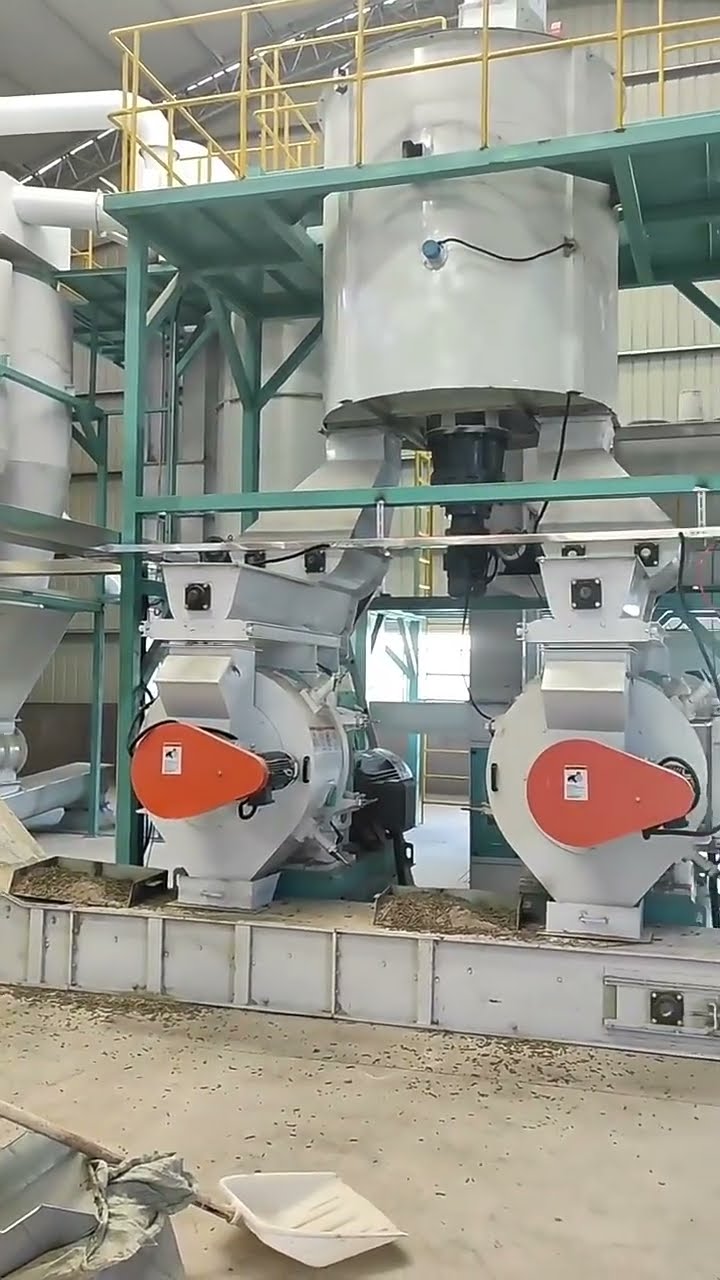
The 2000 kg/h Ring Die Feed Pellet Line in Our Workshop and on Site
Not renders — ring die lines assembled and run before dispatch, and the same machines installed in customer buildings.
What we check before it ships
Every 2000 kg/h feed pellet line is assembled on our floor first: the loader is aligned to the mixer outlet and the mill hopper, the die and rollers are set with a feeler gauge to the clearance your material needs, the cooler fan is balanced, and the cabinet is wired and run for two hours on your motor voltage before it is broken down for export.
The die is the part that decides how the first month goes. Tell us the pellet diameter, the animal and whether the formula carries molasses, and the mill leaves with the compression ratio and the roller gap already set for it — a ring die that arrives tuned runs properly on day one instead of after a week of trial and error.


Running Cost and Payback for a 2000 kg/h Ring Die Feed Pellet Line
At 2 t/h and eight hours a day the line turns out about sixteen tons of feed. Payback comes from the gap between bought feed and home-mixed feed, so your local prices decide the number; the table below is the arithmetic to put them into.
| Scenario | Output per day | Typical saving vs bought feed | Indicative payback |
|---|---|---|---|
| Large farm or feedlot, feeding only | 16 t/day | USD 25–50 per ton | 6–12 months |
| Farm + selling surplus bagged | 16 t/day | USD 40–70 per ton | 4–9 months |
| Feed business, one shift | 16 t/day | USD 50–90 per ton | 3–7 months |
Assumes 8 running hours at 1,500–2,500 kg/h and a raw material cost typical for maize and soybean meal formulas. Power is the other running cost: 107 kW installed, so at 2 t/h the ceiling is about 54 kWh per ton and in practice you draw less, because the loader and the cooler fan are not at full load all the time. Add steam if you condition — a boiler and the steam itself are a real cost, and they are the reason a conditioned ring die line is not automatically cheaper per ton than a flat die line. Send us your local feed, grain and fuel prices and we build the payback sheet with your numbers.
2000 kg/h Ring Die Feed Pellet Line Questions
What machines are included in the 2000 kg/h ring die feed pellet line?
Can the 2000 kg/h ring die feed pellet line be customised?
Should I take a ring die or a flat die for 2000 kg/h?
How is this different from the 5000 kg/h ring die feed pellet line?
Is 2000 kg/h realistic for one HM-320?
Do I need the steam conditioner?
How much floor space and headroom does it need?
What power supply does it need?
What is the delivery time and how does it ship?
Can the same 2000 kg/h ring die feed pellet line make aquatic feed?
Ask for a proposal for your 2000 kg/h ring die feed pellet line
Send your raw material, the animals you feed, your available power and the stages you want in the line. You get the machine list, a dimensioned layout drawing and a landed budget for that configuration within 12 hours. Send the details to info@pelletmachines.net or WhatsApp +86 186 0385 1787.
Your 2000 kg/h Ring Die Feed Pellet Line, Configured Around Your Process
Tell us what you grind, what you feed and which stages you want. We come back with a machine list, a dimensioned layout drawing and an investment range for exactly that configuration — no obligation and no sales sequence.


