
2000 kg/h Feed Pellet Production Line Two Flat Die Mills, One Continuous Line
A complete 2000 kg/h feed pellet line built around two PM-400 flat die feed pellet mills fed from one divided hopper: grind, mix, convey, pellet and cool in a single run, on a 25 × 6 m floor allowance and 110 kW. Two 400 mm dies is how a flat die plant reaches two tons an hour without a tower — and because the machine list is written for your formula, any stage in it can be added, removed or upsized before we quote.
Price depends on how much of the plant you take — the machine list is written for your process, not copied from a catalogue. Tell us the stages you need and we return the equipment list, a dimensioned layout drawing and a landed quote within 12 hours.

What the 2000 kg/h Feed Pellet Line Contains
Six items and 110 kW, each machine sized so that neither PM-400 ever waits for material. This is the configuration on our factory sheet for the 2000 kg/h feed pellet line — every stage below can be changed, and machines you do not need are left out of the quote rather than sold as part of a package.
FS500 feed hammer mill
30 kW on a 500 mm rotor with 24 manganese hammers and 3–8 mm screens. The larger motor is what lets one crusher keep two pellet mills fed; cyclone and ducting discharge straight into the mixer.
WJ-500 horizontal ribbon mixer
7.5 kW, 500 kg batch, double ribbon on a heavy-duty reducer — mash, premix and additives blended to ≥95% uniformity in 3–6 minutes, then discharged into the screw loader.
LX160 screw conveyor
3 kW, 4,500 mm reach. Lifts mixed mash from the mixer outlet into the divided hopper above the two mills, so the line stays low and cheap to build instead of needing a bucket elevator tower.
2 × PM-400 flat die feed pellet mill
30 kW each, 400 mm die, three rollers, 800–1,200 kg/h each. Two mills share the load, so the 2000 kg/h feed pellet line runs at two tons an hour on 2–8 mm pellets by die change.
NL-11 pellet cooler, 7 kW
Pellets leave a flat die at 60–80 °C and soft. The NL-11 pulls air through the bed until they are within a few degrees of ambient, which is the difference between bagging the same day and finding a mouldy ton a fortnight later. At two tons an hour this is not a stage you can skip, and it is the machine most often left off a cheap quotation.
One control cabinet (110 kW) runs the whole 2000 kg/h feed pellet line: a separate starter per motor, overload protection and ammeters on both mills and the cooler fan. Two mills means two ammeters side by side — the operator trims the feed to keep them even, which is also how you spot a worn die on one side before it costs you a shift.

2000 kg/h Feed Pellet Line — Machine Configuration
This is the configuration from our factory sheet. Motor voltage, die thickness and pellet diameter are set to your material before shipment, and the machine list itself is adjusted to your process: the hammer mill comes out if you buy pre-ground mash, a grading sieve or a bagging line goes in, and a third mill can be added if you want headroom.
| Stage | Equipment | Model | Power | Dimensions L×W×H (mm) | Qty |
|---|---|---|---|---|---|
| 1. Grinding | Feed hammer mill | FS500 | 30 kW | 1340 × 950 × 1350 | 1 |
| 2. Mixing | Horizontal ribbon feed mixer | WJ-500 | 7.5 kW | 2500 × 1050 × 2250 | 1 |
| 3. Conveying | Screw conveyor / loader | LX160 | 3 kW | 4500 × 800 × 1850 | 1 |
| 4. Pelleting | Flat die feed pellet mill | PM-400 | 30 kW each | 1260 × 510 × 1250 | 2 |
| 5. Cooling | Pellet cooler | NL-11 | 7 kW | — | 1 |
| 6. Control | Control cabinet for the line | — | 110 kW total | — | 1 |
Installed power 110 kW — 30 + 7.5 + 3 + 2 × 30 + 7 = 107.5 kW of motors on a 110 kW cabinet rating. The sheet quotes a 25 × 6 m floor allowance with 6 m headroom; the dimensioned drawing in the same folder measures 17,888 mm of machine from loader to bagging point, 6,575 mm deep, and 4,861 mm to the top of the cyclone, so the 25 m figure is the allowance with working space and the raw-material end included. Output is quoted for dry grain mash at 12–15% moisture; sawdust runs at roughly half.
What the 2000 kg/h feed pellet line needs at your site
- Floor: 25 × 6 m of level concrete with 6 m headroom, and one 380 V three-phase supply of 110 kW.
- Water: none. Steam: none on this build — a conditioner is an option if you pellet high-molasses or high-fibre formulas.
- Raw material: grain or maize under 14% moisture; a covered store next to the line is enough.
- Operators: one person can run the line; two makes filling and bagging faster.
Every machine in the line is optional
We configure the 2000 kg/h feed pellet line around your process, not the other way round. Buy pre-ground mash and the hammer mill comes out. Bag by hand and the packing line never goes in. Want dust control, a buffer silo and a variable-speed feeder because your formula is light and dusty? We add them and re-lay the line. Want 3 t/h later? A third mill bolts onto the same hopper. Nothing in the table above is compulsory.
Quick quote — 2000 kg/h feed pellet line
Tell us the raw material, the animal you feed, whether you have three-phase power and which stages you want in the line. We reply with the machine list, a dimensioned layout drawing and the landed price for that configuration. Send the details to info@pelletmachines.net or WhatsApp +86 186 0385 1787 — engineers reply within 12 hours.
How the 2000 kg/h Feed Pellet Line Runs, Stage by Stage
Five working stages plus a cabinet to start and stop them, laid in one straight run. The only real difference from a 1 t/h line is stage four: instead of one mill there are two, fed from a hopper split down the middle.
- 1 · GrindingFS500 hammer mill, 30 kW — grain to mash under 3 mm, cyclone discharge into the mixer
- 2 · MixingWJ-500 ribbon mixer, 7.5 kW — 500 kg batch, mash plus premix and additives to ≥95% uniformity
- 3 · FeedingLX160 screw conveyor, 3 kW — lifts mash into the divided hopper; each half feeds one mill
- 4 · Pelleting2 × PM-400 flat die mills, 30 kW each — 800–1,200 kg/h each, 2–8 mm pellets by die change
- 5 · CoolingNL-11 cooler, 7 kW — pellets down to ambient before the bag or the bulk store

The 2000 kg/h Feed Pellet Line on Video
Two clips: the first walks through the flat die production lines we build from 200 kg/h to this size, the second is a flat die feed pellet line running — the same crushing, mixing, pelleting and cooling sequence described above, filmed at working speed.

Our Feed Pellet Production Lines Show
The flat die feed pellet production lines we build, from a single mill on a frame to a complete line with crusher, mixer, cooler and bagging.
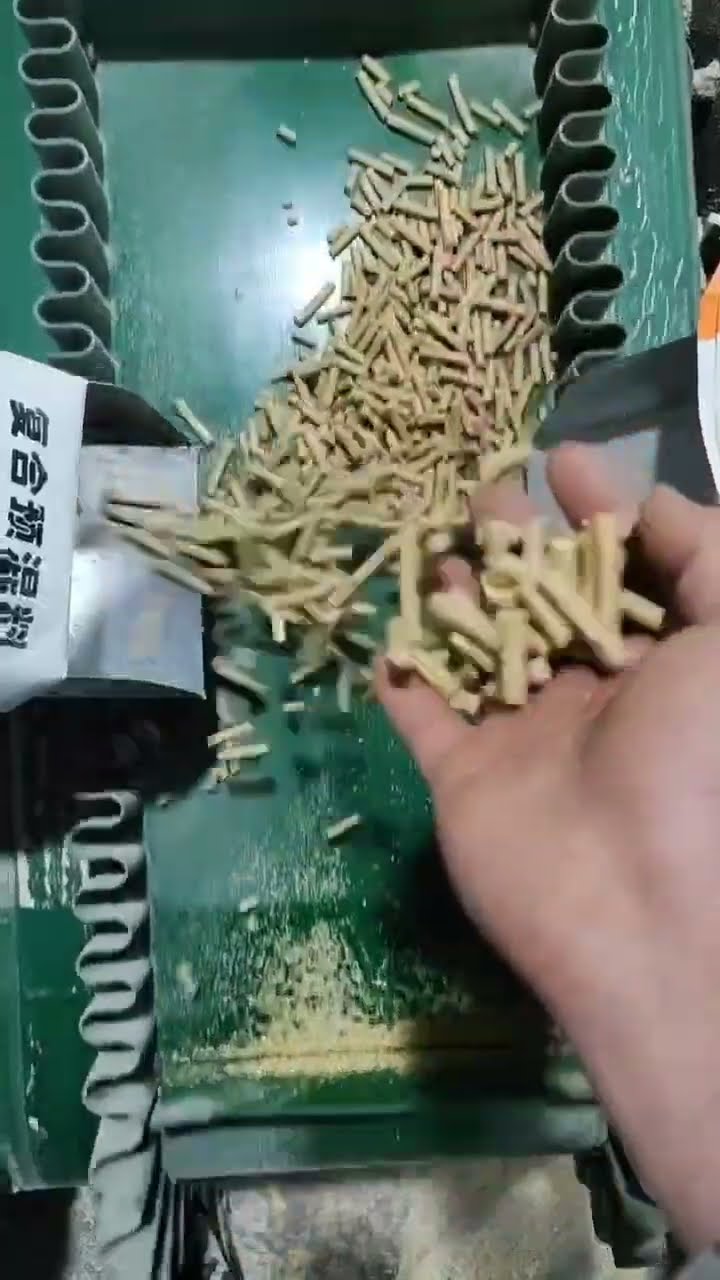
Flat Die Feed Pellet Production Line Working Show
Pellets coming off a flat die feed pellet line at working speed — die, rollers, knife and the finished pellet on the discharge belt.
Machines We Can Add to Your 2000 kg/h Feed Pellet Line
We do not sell one fixed package. The 2000 kg/h feed pellet line is assembled to your process: tell us the raw material, the animals, the formula and how the feed leaves the plant, and we add, remove or upsize any stage. Everything below is quoted as part of the same line — with the original order or as a later upgrade.
Rotary feed pellet grading sieve
Separates whole pellets from crumbs and dust; fines go back through the mill instead of into the bag.
Vibrating feed pellet sieve
The two-deck alternative when you want a tighter size split on 2–4 mm pellets.
Weighing & packing system
5–25 kg bags at ±0.2% accuracy, with belt conveyor and sewing head. At two tons an hour you are filling a bag every few seconds — this is the stage that decides your labour cost.
Automatic batching system
Weighs each ingredient by recipe instead of by hand — needed once you sell more than one formula.
PLC control system
Sequenced start/stop, interlocks and production reporting for the whole line, including both mills.
Feed pellet crumbler
Rolls pellets into crumbles for chick and starter feed, downstream of the cooler.
Molasses / liquid adding machine
Adds molasses, oil or fat evenly after mixing, before pelleting — the usual reason a 2 t/h line needs a conditioner.
Ring die feed pellet mill
The other way to reach 2 t/h: one HM-320 ring die mill instead of two flat dies. See the 2000 kg/h ring die feed pellet line.
Beyond these: dust collection with an airlock and bag filter, a 1–2 m³ buffer silo with a variable-speed feeder, a third PM-400 on the same hopper, bulk bag filling, a second cooler, a magnet and safety screen before the mill, and steam conditioning with a boiler. Describe the process and we quote the machine for it rather than selling you a stage you will not use.
Floor Space for the 2000 kg/h Feed Pellet Line
These are dimensioned drawings from the same file as the factory sheet, not sketches: the twin-mill 2000 kg/h feed pellet line in elevation and in plan. Length is set by the sequence crusher → mixer → hopper → two mills → cooler, plus whatever bagging section you add; height is set by the cyclone.


Machine positions shift by a few hundred millimetres with motor frame size and cyclone height. Send us your building dimensions and the stages you want, and we return a plan marked to your floor — including a version with the two mills at 90° to the line if your bay is narrow.
The 2000 kg/h Feed Pellet Line in Our Workshop
These are not renders — these are twin-mill flat die lines assembled and run before dispatch, in different configurations for different customers.
What we check before it ships
Every 2000 kg/h feed pellet line is assembled on our floor first: the screw loader is aligned to the mixer outlet and to the split in the hopper, both mills are shimmed level to the same height so the feed is even, the cooler fan is balanced, and the cabinet is wired and run for two hours on your motor voltage before it is broken down for export.
That is also when the dies are chosen. Tell us the pellet diameter and the raw material, and both mills leave with the die and the roller gap already set — two machines that arrive tuned run the same on day one instead of one running rich and one running lean.

Running Cost and Payback for a 2000 kg/h Feed Pellet Line
At 2 t/h and eight hours a day the line turns out about sixteen tons of feed — enough for a large farm, a co-operative, or a feed business selling bagged pellets. Payback comes from the gap between bought feed and home-mixed feed, so your local prices decide the number; the table below is the arithmetic to put them into.
| Scenario | Output per day | Typical saving vs bought feed | Indicative payback |
|---|---|---|---|
| Large farm or feedlot, feeding only | 16 t/day | USD 25–50 per ton | 6–12 months |
| Farm + selling surplus bagged | 16 t/day | USD 40–70 per ton | 4–9 months |
| Feed business, one shift | 16 t/day | USD 50–90 per ton | 3–7 months |
Assumes 8 running hours at 1,600–2,400 kg/h and a raw material cost typical for maize and soybean meal formulas. Power is the other running cost: 110 kW installed, so at 2 t/h the ceiling is about 55 kWh per ton and in practice you draw less, because the loader and the cooler fan are not at full load all the time. Send us your local feed and grain prices and we build a payback sheet with your numbers instead of ours.
2000 kg/h Feed Pellet Line Questions
What machines are included in the 2000 kg/h feed pellet line?
Can the 2000 kg/h feed pellet line be customised?
Why two PM-400 mills instead of one ring die mill?
How is this different from the 1000 kg/h feed pellet line?
Is 2000 kg/h realistic for two flat die mills?
Can I run only one mill?
How much floor space and headroom does it need?
What power supply does it need?
What is the delivery time and how does it ship?
Can the same 2000 kg/h feed pellet line make wood pellets?
Ask for a proposal for your 2000 kg/h feed pellet line
Send your raw material, the animals you feed, your available power and the stages you want in the line. You get the machine list, a dimensioned layout drawing and a landed budget for that configuration within 12 hours. Send the details to info@pelletmachines.net or WhatsApp +86 186 0385 1787.
Your 2000 kg/h Feed Pellet Line, Configured Around Your Process
Tell us what you grind, what you feed and which stages you want. We come back with a machine list, a dimensioned layout drawing and an investment range for exactly that configuration — no obligation and no sales sequence.


