
Livestock Feed Hammer Mill Medium-Fine Grinding for Pig, Cattle and Sheep Feed
Livestock feed does not need the fine grind that poultry feed does, and grinding it finer than necessary just wastes energy. This series is sized for the medium particle sizes cattle, pig and sheep rations actually require, at 3–7 t/h — the range most livestock feed operations run.
Reference FOB price: USD 3,200 – 8,500 by model and power configuration. Sieve and air-system sizing included in every quote.

Right-Sized Grinding for Livestock Rations
This series uses a 560 mm rotor at 2,980 rpm — a faster, smaller rotor than the poultry series — which suits the medium grind that ruminant and pig feed needs while keeping motor size and energy use in check.

Medium grind
Weaner, grower and finisher rations; medium particle size supports good pellet binding.
Coarser grind
Coarser sieves handle fibrous roughage without over-grinding and wasting power.
3–7 t/h
Sized for farm cooperatives and regional feed producers rather than industrial plants.
Efficient
Not grinding finer than needed is the single biggest energy saving in the plant.
Livestock Feed Hammer Mill Specifications
Two models, each available with two motor options. Choose the model by target tonnage and the motor by how fine you need to grind.
| Model | Rotor dia. (mm) | Spindle speed (rpm) | Hammer tip speed (m/s) | Chamber width (mm) | Hammer qty | Power (kW) | Air volume (m³/min) | Output (t/h) |
|---|---|---|---|---|---|---|---|---|
| ZW36A | 560 (570) | 2,980 | 87 (89) | 360 | 48 | 22 / 37 | 25 | 3–5 |
| ZW40A | 560 (570) | 2,980 | 87 (89) | 400 | 56 | 37 / 45 | 45 | 5–7 |
Output is for grain at about 14% moisture with a 3 mm sieve. Coarser sieves raise throughput; finer sieves and high-fibre material reduce it.
Which model for which operation
ZW36A — 3–5 t/h. Suits a farm cooperative, a large integrated farm, or the livestock line of a mixed feed plant.
ZW40A — 5–7 t/h. For regional feed producers and plants running two shifts.
Do not over-grind livestock feed
Ruminants need some effective fibre; over-grinding raises energy cost and can cause digestive problems. Pig feed benefits from medium grinding, but grinding to poultry fineness wastes power for no gain.
We help you choose the sieve that balances pellet quality against energy cost.
Quick quote — livestock hammer mill
Tell us the animals, material and target t/h. We reply with the model, power option and sieve specification. Send the details to info@pelletmachines.net or WhatsApp +86 186 0385 1787 — engineers reply within 12 hours.
Impact Grinding and Screening in Four Steps
Simple machine, three settings that matter: tip speed, sieve hole size and airflow.
Feeding
Controlled feeder meters material into the chamber — never free-fall from a hopper.
Impact
Hammers at 87–89 m/s strike the grain; particle-on-particle collision does much of the work.
Screening
Material exits through the sieve once small enough; oversize is struck again.
Air assist
Airflow carries fines out and keeps the chamber from heating and blinding the sieve.
Inside a Water-Drop Chamber
The round-bottomed water-drop body follows the rotor, so material keeps circulating past the hammers instead of settling into corners. The screen wraps around most of the rotor, which gives a large open area for the size of the machine — that is where the low energy per ton comes from.
Hammers swing on their pins. A stone or a scrap of metal passes through the chamber instead of breaking a shaft, which is the difference between a ten-minute check and a week of downtime on a farm plant.
The sieve sits in a front carriage: pull the handle, lift the old screen out, slide the new one in. Going from 2 mm for weaner feed to 4 mm for cattle is one person and a few minutes.


Feed hammer mill — structure and working principle
Walk-through of the grinding chamber, rotor, hammers and sieve.
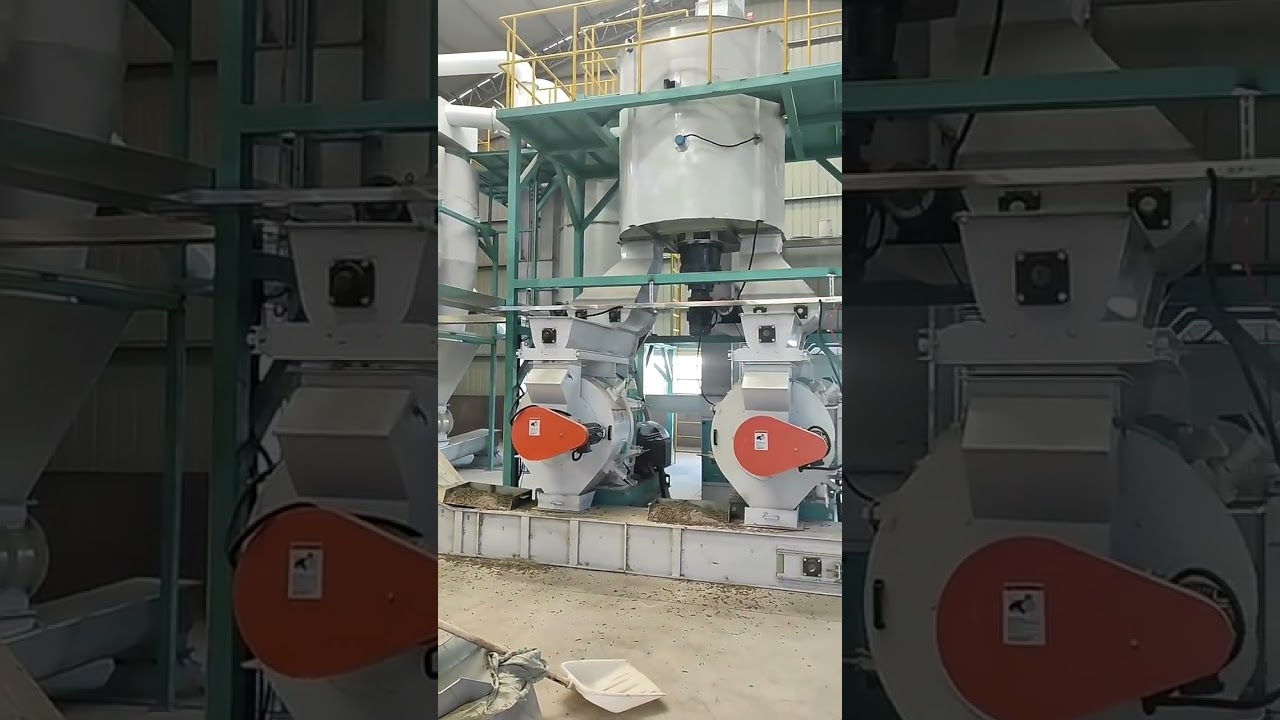
4 TPH ruminant animal feed pellet plant — short clip
A ruminant feed plant running at roughly the throughput this mill serves.
Particle Size by Animal — Get This Right and Save Energy
Grinding finer than the animal needs costs power for no gain. This table is what we work from.
| Animal | Recommended sieve (mm) | Why | Energy note |
|---|---|---|---|
| Pig — weaner | 2.0–2.5 | Finer grind improves digestibility in young pigs | Higher energy per ton |
| Pig — grower / finisher | 2.5–3.0 | Balance of pellet binding and energy cost | Moderate |
| Cattle — dairy | 3.0–4.0 | Effective fibre needed for rumen function | Lower energy per ton |
| Cattle — beef | 3.0–5.0 | Coarser is fine; saves energy | Lowest energy per ton |
| Sheep & goat | 3.0–4.0 | As for cattle, adjusted for roughage share | Low |


If you have not measured it, most livestock operations grind too fine. Moving one sieve size coarser often cuts grinding energy by 10–20% with no loss in animal performance.

From Our Assembly Floor to Your Plant
Every mill is assembled on its frame, aligned and run before it is packed, so what arrives has already turned under power rather than being a crate of parts.
The base frame is drilled for bolting to a concrete plinth or a steel structure, and the inlet and outlet flanges are matched to the conveying you already have. Replacing a mill in an existing line? Send us the old footprint and we will match it.
Built for daily farm-plant duty
The rotor is dynamically balanced after hammer mounting, which is why the mill runs smoothly for years rather than shaking bearings loose in months. Chamber doors interlock so the rotor cannot be reached while it is turning.
Hammers are reversible — when one edge wears, turn them over and get a second service life from the same set. That is the cheapest maintenance saving on the machine.
We ship a spare hammer set and a second sieve with every mill. Both are stocked for fast dispatch, which matters more than the parts cost when the line is waiting.
- 560 mm rotor at 2,980 rpm — sized for medium-fine livestock grinding
- Two models covering 3–7 t/h with four power options
- Reversible hammers double service life per set
- Dynamically balanced rotor for long bearing life
- Air-assisted grinding prevents chamber overheating and sieve blinding
- Spare hammer set and second sieve shipped with the machine
Livestock Feed Hammer Mill Questions
How much does a livestock feed hammer mill cost?
What is the difference from the poultry series?
What throughput should I expect?
Can it grind fibrous roughage?
Do I need the air system?
How often do hammers need replacing?
Can it handle maize as well as other grains?
What is the warranty and spare parts situation?
Ask for a livestock hammer mill recommendation
Send the animals, material, target t/h and required particle size. You get the model, power option and sieve specification within 12 hours. Send the details to info@pelletmachines.net or WhatsApp +86 186 0385 1787 — engineers reply within 12 hours.
Grinders, Mixers and Line Equipment
- Poultry Feed Hammer Mill
- Wide Chamber Feed Hammer Mill
- Ultra Fine Feed Hammer Mill
- Feed Ribbon Blender
- Double Paddle Feed Mixer
- Farm-use Ring Die Pellet Mill
- Feed Pellet Production Line
- Automatic Batching System
- Three Sets Hammer Mill to Palestine
- Plant Installed in Bangladesh
- Pellet Mill to Pakistan
- PLC Control System
Get Your Livestock Grinder Specified Correctly
Send the animals, material and target throughput. You get the model, power option, sieve recommendation and investment range within 12 hours.


